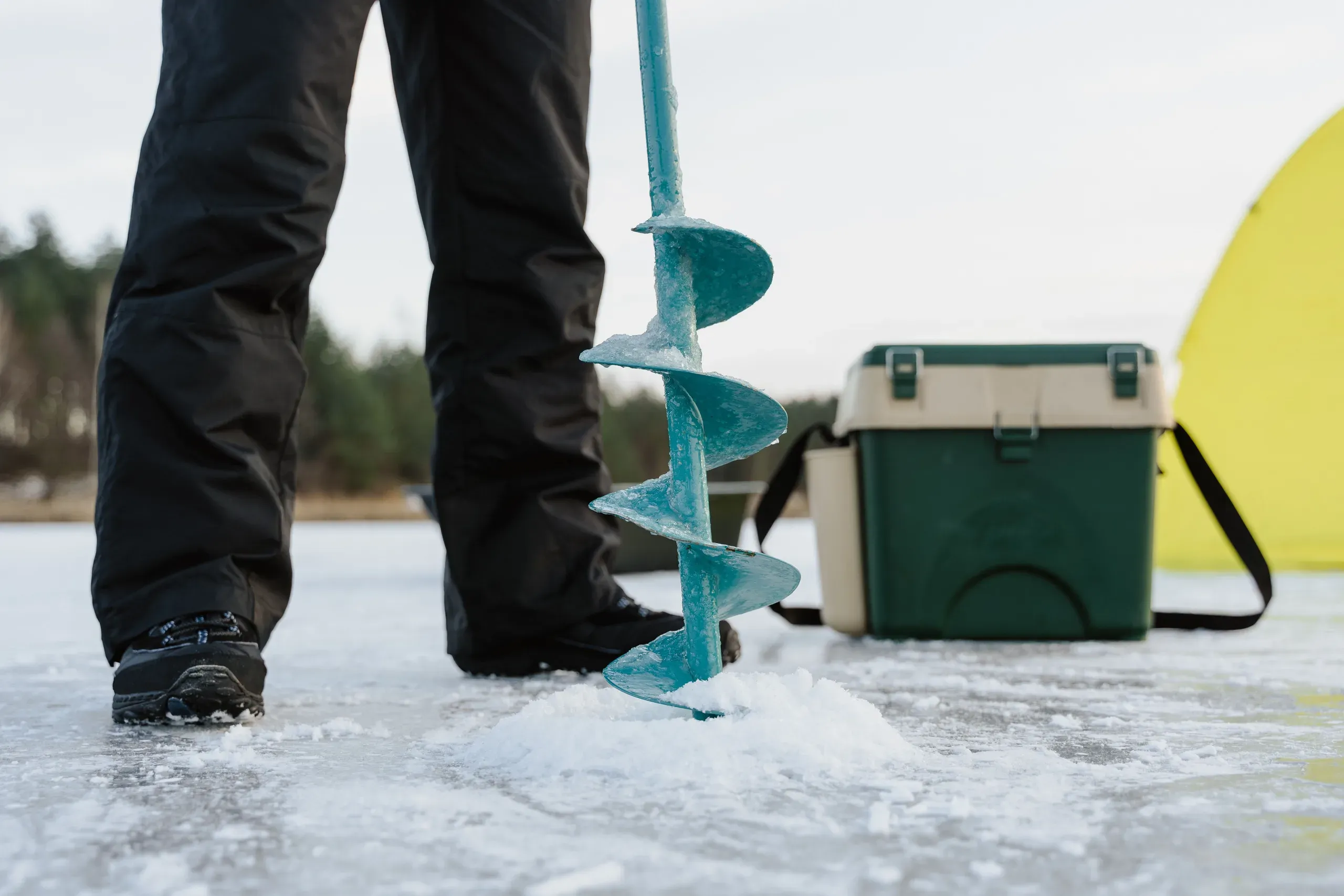
Bring nothing but clothes. A guided trip in Lapland supplies the rod, the jig, the auger, the scoop and something to sit on, because Finnish law defines ice fishing as a short rod with a vertically moved jig on a line and there is nothing else to supply. What you do have to get right is your hands and what is between you and the ice: this is two hours of small, fiddly movements performed sitting still in the open, and cold fingers ruin it long before cold anything else does. Thin liner gloves under mitts, and a closed-cell mat, are the whole packing list.
Type “ice fishing gear” into a search box and you get a world of heated
shelters, sonar flashers, propane heaters, power augers and rod cases with
foam cut-outs. It is a real and serious hobby, and almost none of it has
anything to do with an afternoon on a Finnish lake with a guide.
The gap is worth understanding, because it is the reason people arrive with
the wrong things in their bag and none of the right ones.
The law describes the whole kit
Finland’s public fishing rights define ice fishing narrowly and usefully.
Metsähallitus, the state body that manages fishing on public water, puts it as
fishing with a short rod and a vertically moved jig attached to a
line.1
That is not a simplification for tourists. It is the legal boundary of the
free activity: one short rod, one jig, moved up and down. Add a second rod or
a lure you cast and you are doing something else, which needs the fisheries
management fee and the water owner’s permission.
So the kit list is short because the activity is defined to be short. There is
no equipment arms race to opt into, and an operator who has brought a rod, a
jig, an auger and a scoop has brought everything the day legally consists of.
What comes with a trip and what the sitting around is actually like is set out
on what ice fishing in Lapland is actually like;
read that one to decide whether to book, and this one for what to put in the
bag once you have.
Your hands are the whole problem
Here is the thing nobody puts on a packing list: ice fishing is fine motor
work done sitting still in the open, and that combination is specifically bad
for hands.
The Finnish Institute of Occupational Health, which sets the country’s
guidance on working in the cold, is blunt about what happens as hands cool.
Accuracy and endurance start to go while the hand is still at twenty to
twenty-seven degrees. Dexterity deteriorates between twelve and sixteen. By
sixteen degrees a whole cold hand starts to
hurt.2
Those numbers are about skin temperature rather than air temperature, and
they arrive faster than you expect at minus fifteen, because the tasks are all
small: baiting a hook, tying on a jig, unhooking a perch, working a zip.
The answer is layers on the hands exactly as on the body. Thin liner gloves
you can leave on for everything fiddly, mitts over the top for the rest, and
a habit of putting the mitts back on before you feel you need to. A hand that
has gone properly cold takes twenty minutes to come back, and that is most of
a short session.
Tripadvisor ratings, 18 Rovaniemi operators
Highest first
Snowtrail Safaris 5.0
Nordic Odyssey 5.0
Nordic Adventures 4.9
Arctic GM 4.9
Book Lapland 4.9
Bearhill Husky 4.9
Arctic Attitude 4.9
StayLapland 4.8
Wild About Lapland 4.7
Wild Nordic 4.7
Lapland Winter Park 4.6
Safartica 4.5
Nordic Unique Travels 4.5
Apukka Resort 4.4
Lapland Welcome 4.3
Arctic Circle Snowmobile Park 4.3
Arctic Circle Husky Park 4.2
Raitola 3.4
<44.04.55.0
Ratings read from Tripadvisor. The shaded compartment left of the divider holds any score below 4.0. We record the score only; review counts and review text are not part of our comparison.
What to sit on matters more than what to fish with
Second thing nobody mentions: you are sitting on a metre of ice for two hours.
Operators bring a box or a stool, and it is usually enough. If you are
inclined to be cold, a closed-cell foam sit-mat in a coat pocket weighs
nothing and does more for the afternoon than any piece of tackle. Conduction
through a thin seat is the quiet way this trip goes wrong.
Boots are the other half of it. Thermal overalls and winter boots are lent on
most guided winter activities in Rovaniemi, including the ones that reach the
lake by snowmobile, so this is not a thing to buy – but do wear thin socks
under the thick pair rather than two thick pairs, which compresses the air
that is doing the insulating.
What to actually pack
A buff or scarf for the face. On an open lake there is nothing to stop the
wind, which is the one respect in which sitting on ice is worse than standing
in forest.
Liner gloves. As above. The single highest-value item on this list.
A sit-mat, if you are the one who is always cold.
Sunglasses, in March. Late-winter sun on flat white ice is genuinely
dazzling, and nobody packs them for a trip to Lapland.
A thermos, if you are going alone. On a guided trip there is a fire and
someone else has brought the drinks.
That is the list. Everything with a motor, a screen or a zip-up wall is
somebody else’s hobby.
If you are going without a guide
Then the gear question stops being about comfort and becomes about safety,
and the auger is not the item that matters. Ice thickness is, and it is the
one judgement a visitor genuinely cannot make from the shore.
Ice fishing in Rovaniemi covers what the
guided trips in and around the town include and what they cost; the
private trip with a snowmobile sleigh is
the version where somebody else takes both the equipment decision and the ice
decision off you. If sitting still for two hours does not sound like your
afternoon at all, the
snowmobile and ice fishing combination
exists precisely because half of every party feels that way.
Should we buy an ice fishing tent or shelter before we come?
No. On a guided trip you will either be in the open beside a fire or in a shelter the operator has already put up, and nobody expects you to arrive carrying one. The shelters you see in photographs of Finnish lakes belong to people who are out for six hours in a wind, and they exist to solve a problem a two-hour guided session does not have. If the forecast is genuinely unpleasant the guide will move the trip or shorten it, which is a better answer than a tent you carried from another country.
Can we hire an auger and go out on our own instead?
You can, and augers are hired in most resorts, but understand what you are taking on. The guide is not there for the fishing – jigging takes about a minute to learn – but for the choice of lake and the judgement about that week's ice, and that second part is the one a visitor cannot make. Nobody can read a Finnish lake from a hotel window: thickness varies across a single bay, currents and inflows thin it invisibly, and the safe answer changes after every mild spell.
What about a fishing licence – is any of this included in the price?
For jigging there is nothing to include, because it is free for every age under Finland's public fishing rights, and that is true whether you are with a guide or alone. Where the exceptions bite is specific waters rather than general rules: running water with migratory fish, areas closed to fishing, and a handful of named lakes that sell their own permit. A guide takes you somewhere the question does not arise, which is a small convenience rather than a saving.
Lapland Handbook is written by its editorial staff in Rovaniemi. Every price, age limit and group size in a comparison is read from the operator's own page and marked "Not stated" when the operator does not publish it. Each guide names who should not book, and names the operator that suits each kind of group, whichever it is.
Rovaniemi's winter tours do sell out – December and the week around New Year first, and the small-group ones before the rest. Booking here goes straight to the operator at their own published price, and the code LH10 takes 10% off it.
We would like to count visits, so we can see which guides get read. That needs a cookie. Nothing else on this site does, we show no advertising, and refusing changes nothing about what you can read or book. What we measure and why.