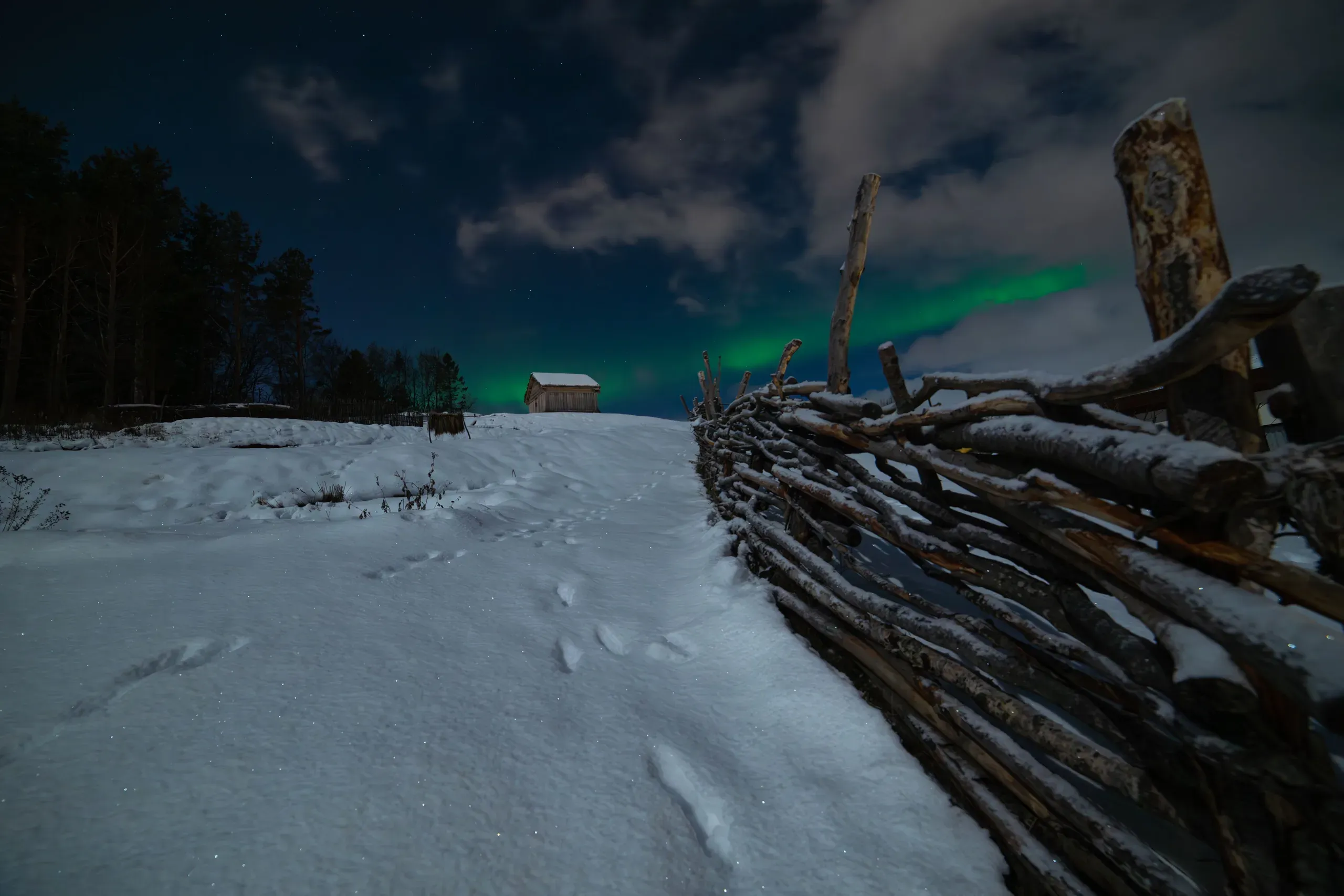
About one dark, cloudless night in two, which is the Meteorological Institute's figure for central Lapland and explicitly includes Saariselkä – the same bracket as Levi and Ylläs, not a better one. Kilpisjärvi is the place with markedly higher odds at three nights in four. What Saariselkä adds is geography rather than latitude: the village sits 25 kilometres from Ivalo Airport, surrounded by open fell and with Urho Kekkonen National Park starting at its edge, so walking out of the lit area takes minutes rather than a minibus. The aurora peaks around midnight, give or take a couple of hours, in every month of the season.
Saariselkä is sold as the far north – the place where the aurora stops being a
gamble. The first part is true. The second is not, and the figures that show it
come from the institute that measures them.
The number is about one night in two
The Finnish Meteorological Institute’s research pages give aurora probabilities
by region, per dark and cloudless night. Kilpisjärvi, in the north-western arm
of the country, gets about 75 per cent. Central Lapland – and the page names
the ski resorts Ylläs, Levi and Saariselkä together – gets roughly 50 per cent.
Central Finland, Oulu and Kuusamo, about 25. The south coast averages once a
month.1
Two things follow that the marketing does not mention.
The first is that Saariselkä is in the same bracket as Levi and Ylläs. It is
further north, and on a long enough run of nights that will show, but it is not
a different category of place. If you were choosing between the three on aurora
odds alone, the institute’s own grouping says the choice barely matters. The
one place that is genuinely in another class is Kilpisjärvi, which almost
nobody visits.
The second is the phrase “dark and cloudless”. Half of nothing is nothing, and
cloud is what ends most aurora attempts in Finland. The odds above are the
ceiling, not the forecast.
What Saariselkä actually gives you
Darkness within walking distance, which is a more useful thing than it sounds.
The village sits 25 kilometres from Ivalo Airport, directly on the E75, and is
surrounded by open fells and Urho Kekkonen National Park, which stretches east
from the village all the way to the Russian
border.2
That geography is the argument. Light pollution washes out a weak display long
before cloud does, and at Saariselkä the unlit ground starts where the
buildings stop. In most Lapland resorts getting away from the streetlights is a
drive; here it is a walk, and on a clear night that difference is worth more
than the extra degree of latitude.
Our comparison of
where else in Finland to see the northern lights
ranks the alternatives on exactly this basis – how far the dark is from your
bed – and Saariselkä comes out well on it. Read that page if the destination is
still open, and this one if it is already booked.
Tripadvisor ratings, 18 Rovaniemi operators
Highest first
Snowtrail Safaris 5.0
Nordic Odyssey 5.0
Nordic Adventures 4.9
Arctic GM 4.9
Book Lapland 4.9
Bearhill Husky 4.9
Arctic Attitude 4.9
StayLapland 4.8
Wild About Lapland 4.7
Wild Nordic 4.7
Lapland Winter Park 4.6
Safartica 4.5
Nordic Unique Travels 4.5
Apukka Resort 4.4
Lapland Welcome 4.3
Arctic Circle Snowmobile Park 4.3
Arctic Circle Husky Park 4.2
Raitola 3.4
<44.04.55.0
Ratings read from Tripadvisor. The shaded compartment left of the divider holds any score below 4.0. We record the score only; review counts and review text are not part of our comparison.
The hours matter more than the place
The institute puts the typical display at around midnight, and a couple of
hours either side.1
That is the same window everywhere in Finland, which is why it is the most
portable piece of advice on this site. It also explains the most common failure
mode: people go out at nine, see nothing, conclude the night was a write-off
and go to bed before the best two hours have arrived.
The other thing worth knowing about timing is the season. The same pages note
that auroras occur fairly evenly through the year, slightly more often around
spring and autumn than in midwinter, and that the best time in Northern Finland
is March and early April – darkness and weather working
together.1 Our page on
which month to come works
through what that means for a trip, and the arithmetic holds this far north
with one amendment: December here is properly dark rather than merely dim.
What a tour adds, and what it does not
Mobility, and someone else’s judgement about where the clear sky is. That is
the whole of it, and it is set out at length in the
northern lights guide.
At Saariselkä that matters slightly less than elsewhere, because you can reach
darkness on foot. It still matters on the nights when the cloud is sitting over
the village and there is a hole in it forty kilometres away, which is a fairly
ordinary Lapland night.
The tours sold from the village differ mainly in how you wait – on snowshoes,
by a campfire, in a van or on a snowmobile – and
the Saariselkä northern lights tour guide
sets four of them side by side.
The honest summary
Good odds, not exceptional ones. Half of clear nights, the same as Levi
and Ylläs.
Excellent darkness. Better than any of the southern resorts, and reachable
without a vehicle.
Buy nights. Three of them at any of these places beats one of them here,
and that is the only lever in this whole business that you control completely.
Is it worth flying to Ivalo rather than Rovaniemi for the aurora?
Only if you are staying several nights and the aurora is the point of the trip. The odds at Saariselkä are better than at Rovaniemi, but they sit in the same band as Levi and Ylläs rather than in a class of their own, and a second flight costs you most of a day at each end. Three nights at Rovaniemi will beat one night at Ivalo by a wide margin, because every additional night is a fresh draw on the cloud and the cloud is what ends most attempts.
Can we just walk out of the village instead of booking a tour?
Yes, and at Saariselkä this is more realistic than at most resorts, because the fell and the national park begin where the buildings stop. Fifteen minutes on foot gets you away from the street lighting and onto open ground with a clear northern horizon, which is the whole of what a viewing spot needs. What that does not give you is mobility: if the cloud is sitting over the village, walking does not move you out from under it, and a guided chase by vehicle does.
How late do we need to stay up?
Later than most people plan for. The Meteorological Institute puts the typical display around midnight and a couple of hours either side, so the common mistake is stepping outside at nine, seeing nothing and going to bed at ten. That is not a bad night; it is an early one. Plan to be awake and dressed between about ten and one, and treat anything before that as a bonus rather than the attempt itself.
Lapland Handbook is written by its editorial staff in Rovaniemi. Every price, age limit and group size in a comparison is read from the operator's own page and marked "Not stated" when the operator does not publish it. Each guide names who should not book, and names the operator that suits each kind of group, whichever it is.
We would like to count visits, so we can see which guides get read. That needs a cookie. Nothing else on this site does, we show no advertising, and refusing changes nothing about what you can read or book. What we measure and why.