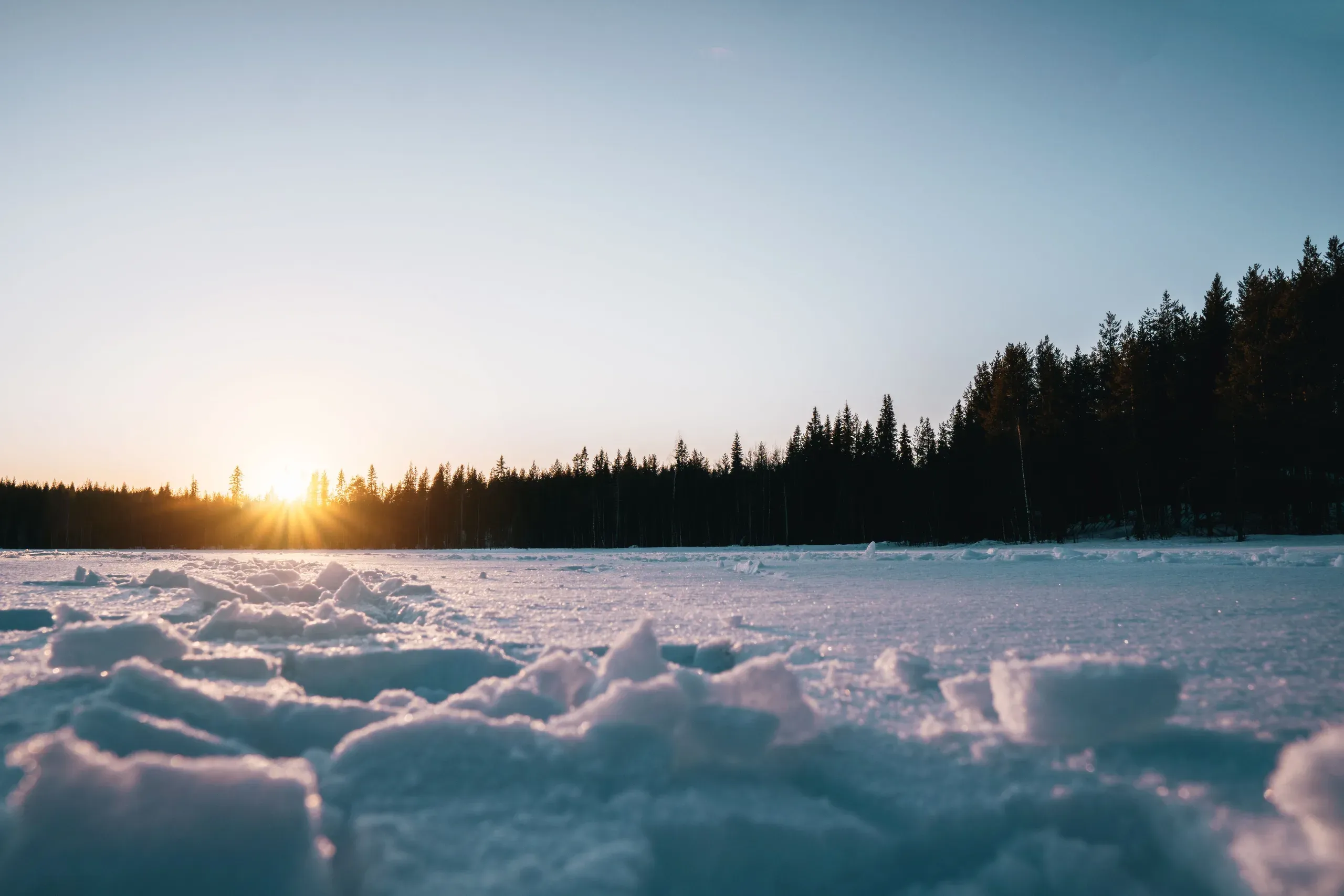
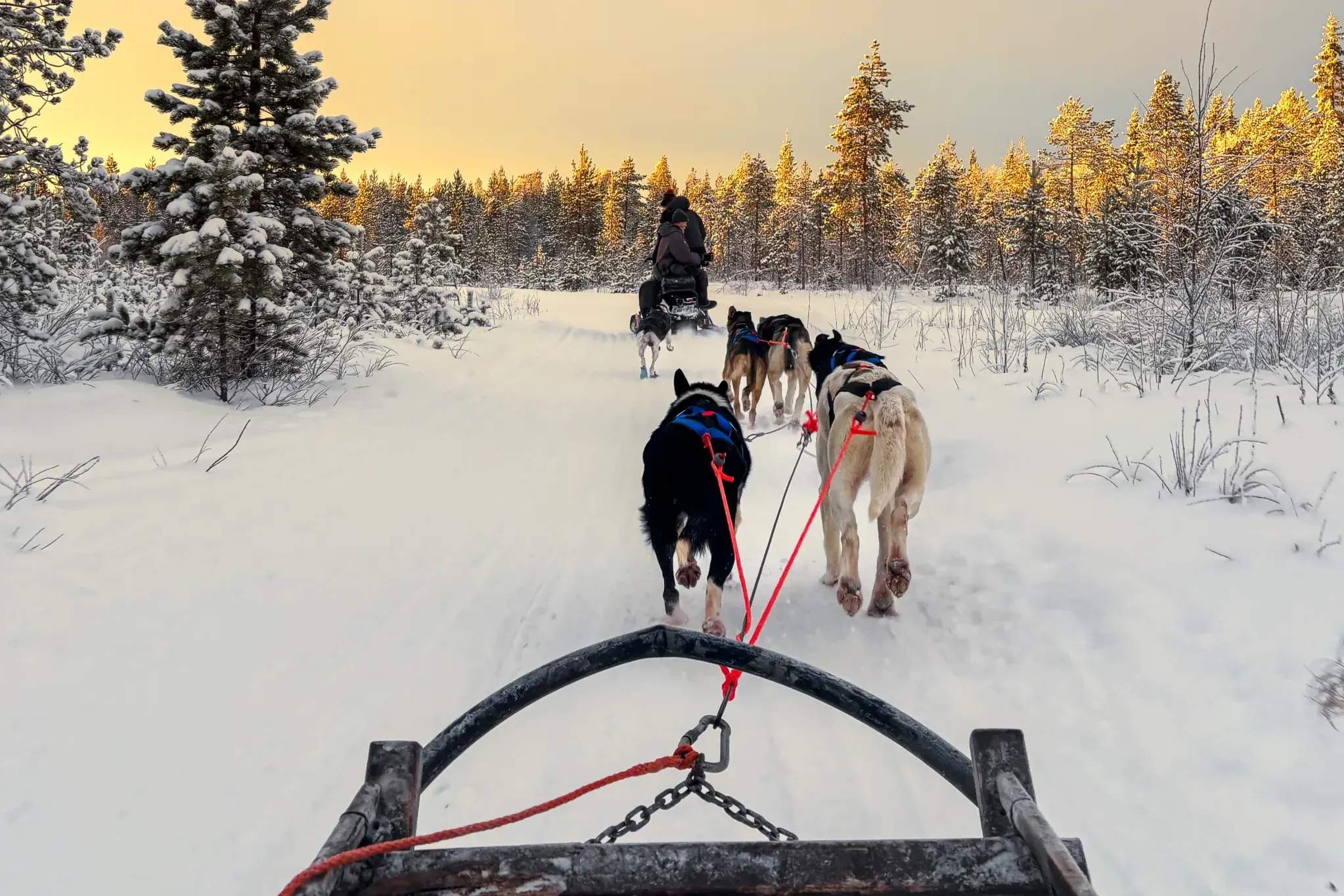
March if you can choose, December if you cannot. The dark-month argument is weaker than it looks: Rovaniemi is on the Arctic Circle, and the Finnish Meteorological Institute notes that daylight there never reaches zero and that midwinter still brings hours of twilight around midday, so December does not buy you a black sky all day. What every month gives you is a dark evening, which is when the aurora is most likely anyway. March adds settled weather and a sky that is properly dark by eight, which is why it is the month to pick when the dates are yours.
Most month-by-month aurora advice rests on an assumption that does not survive
contact with Rovaniemi: that the darkest month gives you the best chance,
because darkness is the raw material.
It is true that you need darkness. It is not true that December supplies
dramatically more of it than March does, and it is worth understanding why
before you book a week in the coldest, shortest part of the winter on the
strength of it.
Rovaniemi never actually loses the sun
Rovaniemi sits on the Arctic Circle, and the Arctic Circle is the line where
the polar night begins rather than somewhere inside it –
what that line actually is is worth
five minutes if you are going to stand on it anyway. The Finnish
Meteorological Institute puts it plainly: at the Arctic Circle the length of
the day never goes to zero, and even at its shortest it is a couple of hours.
In midwinter, when the sun barely shows itself, there are still a few hours of
twilight around
midday.1
So the mental picture of a December day in Rovaniemi as twenty-four hours of
blackness is wrong. What you get is a long blue twilight, a brief pale sun near
the horizon, and dark from mid-afternoon.
That last part is the only part the aurora cares about. And every winter month
in Rovaniemi has a dark evening.
The evening is the whole window
The institute’s figures for when auroras are actually seen make the same point
from the other direction: the probability rises above half by about nine in the
evening, peaks near half past eleven, and falls back below half somewhere
between four and five in the
morning.2
Nine in the evening until midnight is dark in Rovaniemi in November, December,
January, February and March alike. It is also past bedtime in every month, which
is why
the age limit question turns out to
be about the clock rather than the child. The extra darkness December gives you falls
in the middle of the afternoon, which is a time you will be having lunch or
coming back from a husky safari rather than standing on a frozen lake looking
north.
This is why the northern lights guide
tells you to be outside between about ten and midnight rather than telling you
which month to come: the window is the same window all winter.
Tripadvisor ratings, 18 Rovaniemi operators
Highest first
Snowtrail Safaris 5.0
Nordic Odyssey 5.0
Nordic Adventures 4.9
Arctic GM 4.9
Book Lapland 4.9
Bearhill Husky 4.9
Arctic Attitude 4.9
StayLapland 4.8
Wild About Lapland 4.7
Wild Nordic 4.7
Lapland Winter Park 4.6
Safartica 4.5
Nordic Unique Travels 4.5
Apukka Resort 4.4
Lapland Welcome 4.3
Arctic Circle Snowmobile Park 4.3
Arctic Circle Husky Park 4.2
Raitola 3.4
<44.04.55.0
Ratings read from Tripadvisor. The shaded compartment left of the divider holds any score below 4.0. We record the score only; review counts and review text are not part of our comparison.
What actually separates the months
Cloud. This is the real variable, and it is the one nobody can promise you.
A mild overcast December week produces nothing; three cold, still February
nights produce three sightings. Booking on the cloud forecast rather than the
aurora forecast is the single most useful habit for anyone doing this.
Snow and light. Late winter has more snow on the ground and more daylight
to see it in, which changes what the rest of the trip is like even if it
changes nothing about the sky. The
month-by-month activity guide sets out
what is actually running when, including the weeks at either end where seasons
open and close.
What else you are coming for. December is when the
Santa operation is at full strength and
when the whole town is arranged around Christmas. March is when the days are
long enough to do two things and the trails are at their best. Neither of those
is an aurora argument, and both are perfectly good reasons.
The honest recommendation
If your dates are free, March is the best month for the northern lights: you get the equinox period, the
settled late-winter weather, a sky that is properly dark by eight, and enough
daylight to have a real day as well.
If your dates are not free – school holidays, a Christmas trip, whatever it is
– come anyway, and buy nights instead of months. Three evenings in December
beats one in March, and the number of evenings is the one part of this you
control. Where to spend them is a separate question, and
where else in Finland to see the northern lights
takes it on if the town is still open for decision.
No, and nothing here says that. December has long dark evenings, snow on the ground and the whole Santa apparatus running, which is why most people come then. The point is narrower: the reason to come in December is not that it is darker in a way that helps, because the hours you would be out looking are dark in every winter month. Come in December for the Christmas trip and treat the aurora as a bonus, rather than choosing December believing it stacks the odds.
What about the equinoxes? We have read that March and September are best.
The geomagnetic argument for the equinoxes is real and the Finnish Meteorological Institute's own recommendation leans that way. September is the weaker half of it this far north, because the nights are not yet properly dark when the activity peaks. That leaves March carrying the equinox benefit and the clear, settled late-winter weather at the same time, which is why it comes out ahead of both its neighbours and of the autumn.
Does it matter what time of the evening we go out?
More than the month does. The institute puts the probability of seeing an aurora above fifty per cent from about nine in the evening, peaking near half past eleven, and back below fifty per cent between four and five in the morning. A tour that leaves at eight and returns at midnight is built around that window. Watching on your own, the common mistake is stepping out at nine, seeing nothing and going to bed before the best hour has arrived.
Lapland Handbook is written by its editorial staff in Rovaniemi. Every price, age limit and group size in a comparison is read from the operator's own page and marked "Not stated" when the operator does not publish it. Each guide names who should not book, and names the operator that suits each kind of group, whichever it is.
Rovaniemi's winter tours do sell out – December and the week around New Year first, and the small-group ones before the rest. Booking here goes straight to the operator at their own published price, and the code LH10 takes 10% off it.
We would like to count visits, so we can see which guides get read. That needs a cookie. Nothing else on this site does, we show no advertising, and refusing changes nothing about what you can read or book. What we measure and why.