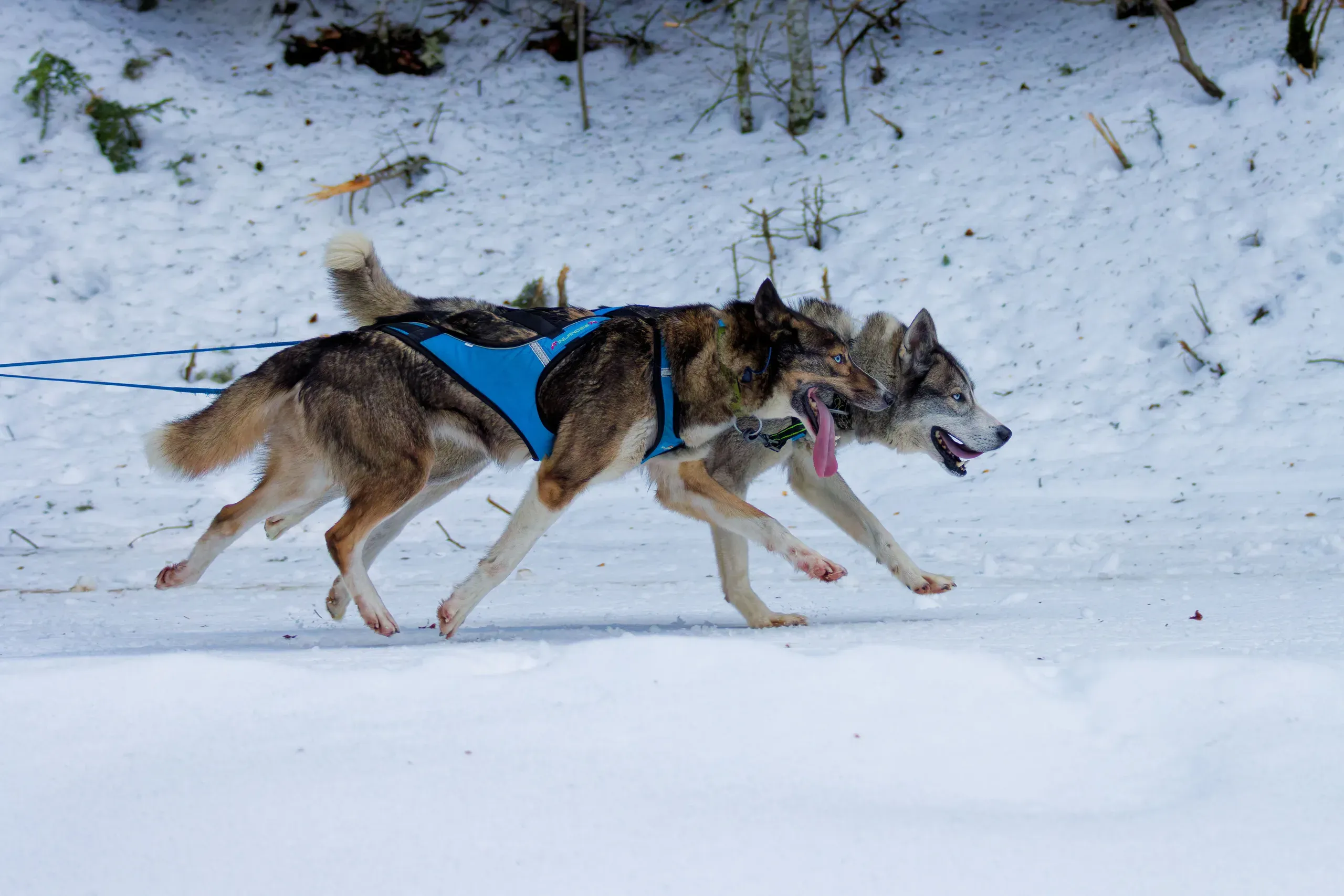
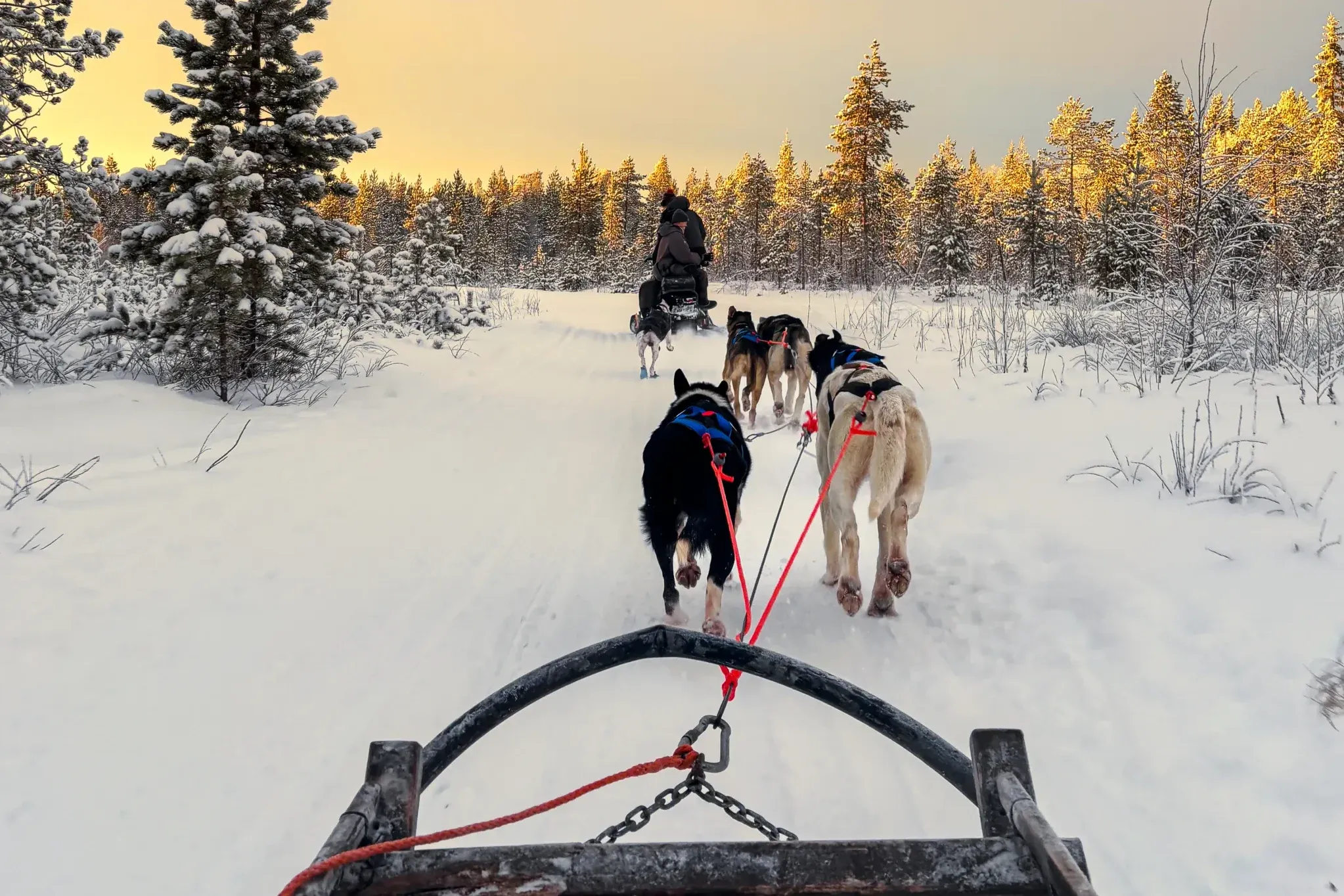
Almost certainly Alaskan huskies, and the Alaskan husky is not a recognised breed. The Fédération Cynologique Internationale lists the Siberian Husky as standard number 270 and the Alaskan Malamute as 243, both in its Nordic sledge dogs section; there is no Alaskan husky on that list, because the Alaskan husky is a working type rather than a breed – a crossbred dog selected for the ability to pull, with no standard describing what it should look like. Expect leaner, longer-legged, more variable dogs than the thick-coated blue-eyed husky of the photographs.
If you book a husky safari in Lapland you will be pulled by Alaskan huskies.
Almost everyone books one, almost nobody is told this, and the reason it is
worth knowing has nothing to do with pedigree snobbery: it explains why the
dogs in front of the sled rarely look like the dog on the website.
Only one of the two names is a breed
The Fédération Cynologique Internationale – the body that maintains breed
standards for most of the world outside the English-speaking countries – lists
the Siberian Husky as standard number 270 and the Alaskan Malamute as 243. Both
sit in Group 5, Spitz and primitive types, section Nordic sledge dogs, and both
are registered as originating in the United States of
America.12
There is no Alaskan husky on that list, and there is no equivalent list it
appears on elsewhere. It is not an oversight. The Alaskan husky is a working
type rather than a breed: a dog bred to pull a sled well, from whatever
ancestry does that best, with no standard saying what it should look like and
no registry recording what went into it.
That is the whole difference, and it produces every other difference.
A breed is described; a type is selected
A breed standard is a description somebody has to meet. It says how tall the
dog should be, what the coat does, what the ears do, which colours are
acceptable. Dogs are bred towards that description, and the ones closest to it
win prizes.
An Alaskan husky is bred towards a result instead. Can it pull, for how long,
at what speed, on what food, without breaking down? Everything else is
negotiable, which is why teams are so visibly varied: taller and leaner than a
Siberian, often shorter in the coat, and frequently mixed in colour and marking
in a way no standard would permit.
Neither approach is better. They are answers to different questions, and
tourism is where the two answers meet awkwardly – because the marketing uses
the photogenic one and the trail uses the fast one.
Tripadvisor ratings, 18 Rovaniemi operators
Highest first
Snowtrail Safaris 5.0
Nordic Odyssey 5.0
Nordic Adventures 4.9
Arctic GM 4.9
Book Lapland 4.9
Bearhill Husky 4.9
Arctic Attitude 4.9
StayLapland 4.8
Wild About Lapland 4.7
Wild Nordic 4.7
Lapland Winter Park 4.6
Safartica 4.5
Nordic Unique Travels 4.5
Apukka Resort 4.4
Lapland Welcome 4.3
Arctic Circle Snowmobile Park 4.3
Arctic Circle Husky Park 4.2
Raitola 3.4
<44.04.55.0
Ratings read from Tripadvisor. The shaded compartment left of the divider holds any score below 4.0. We record the score only; review counts and review text are not part of our comparison.
What this changes for you on the day
Very little, honestly, and that is worth saying plainly. The
husky safari guide sets out the three things
that actually decide whether your safari is good – the trail distance, the size
of the group and whether you drive – and none of them is a function of which
dogs are in front of you. No operator in Rovaniemi advertises by breed, and if
one did, it would not be telling you anything useful.
Two things do change.
The first is expectation. If you have pictured blue eyes and a thick grey mask
and you get a lean brown dog with one ear up, you have not been short-changed;
you have met a working animal. That is the more interesting encounter, but only
if you know it is coming. The moment you meet them is loud and quick, and
the safari minute by minute
describes where in the morning it falls.
The second is what to ask about. Since the type tells you nothing, the
questions worth putting to a kennel are about the kennel: how many dogs, how
often each one runs, and what happens to a dog that stops working. A
farm or kennel visit without a ride is
the format that actually gives you time to ask them, and
what a visit costs against a safari is
set out on the page about the park at Santa Claus Village.
Where the Malamute comes in
Rarely, in Finland, is the honest answer. The Alaskan Malamute is the third
name people meet and it is a genuine breed – heavier, slower, built for hauling
weight rather than for speed. Some kennels keep a few, and they are
unmistakable next to a racing line.
You are unlikely to be pulled by them on a standard half-day safari, because
what a tour wants is a team that can do the same eight kilometres several times
a week at a comfortable trot. That is the job the Alaskan husky exists for, and
it is why it is the dog you will meet.
Are Alaskan huskies a mix of Siberian huskies and something else?
Partly, and that is as precise as anyone can honestly be. An Alaskan husky is defined by what it can do rather than by what went into it, and the crosses behind any given kennel's dogs are that kennel's own business. Northern spitz-type dogs are in there, and so are pointers and hounds in racing lines, which is where the long legs and short coats in some teams come from. There is no registry to consult, because a type with no standard cannot have one.
Does it matter for the dogs' welfare which kind we ride behind?
Not in itself. What matters is the kennel: how many dogs it keeps, how often each dog runs, what the tether or kennel arrangement is, and what happens to dogs that stop working. None of that is visible from the breed, and none of it is on a booking page. If it matters to you, ask the operator directly and judge the answer, rather than judging the dogs by how closely they resemble a picture.
Why do the dogs in the marketing photographs look so different?
Because the photograph is usually a Siberian Husky and the team is usually not. The Siberian Husky is the dog most people picture – dense coat, masked face, often blue eyes – and it photographs beautifully, which is why it ends up on the brochure. A working Alaskan husky is bred for a different job and looks it. Neither is a deception exactly, but if you booked expecting the brochure dog you will notice.
Written by
Lapland Handbook Staff
Lapland Handbook is written by its editorial staff in Rovaniemi. Every price, age limit and group size in a comparison is read from the operator's own page and marked "Not stated" when the operator does not publish it. Each guide names who should not book, and says so when a competitor is the better choice.
Book while the date you want still exists
Rovaniemi's winter tours do sell out – December and the week around New Year first, and the small-group ones before the rest. Booking here goes straight to the operator at their own published price, and the code LH10 takes 10% off it.
We would like to count visits, so we can see which guides get read. That needs a cookie. Nothing else on this site does, we show no advertising, and refusing changes nothing about what you can read or book. What we measure and why.