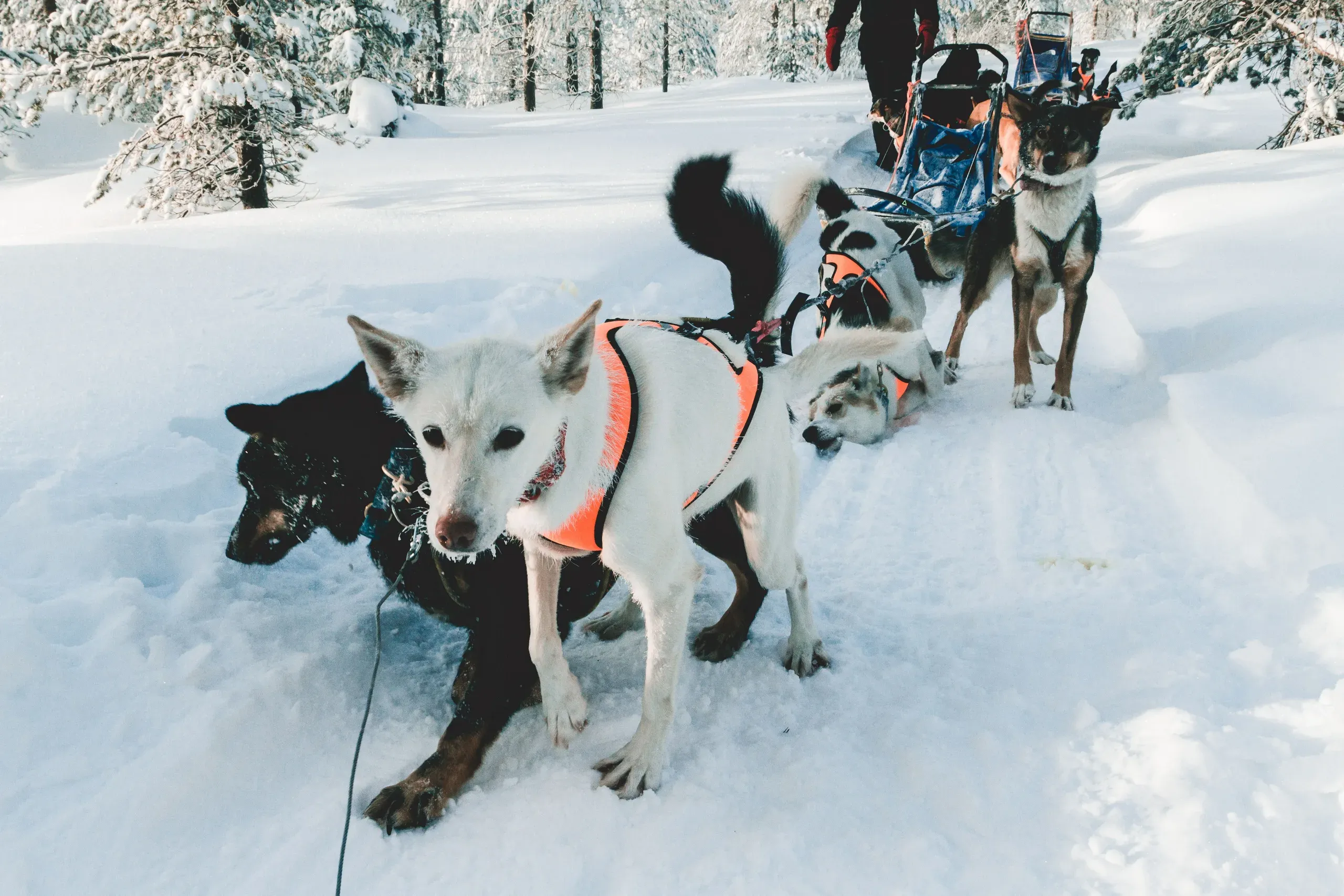
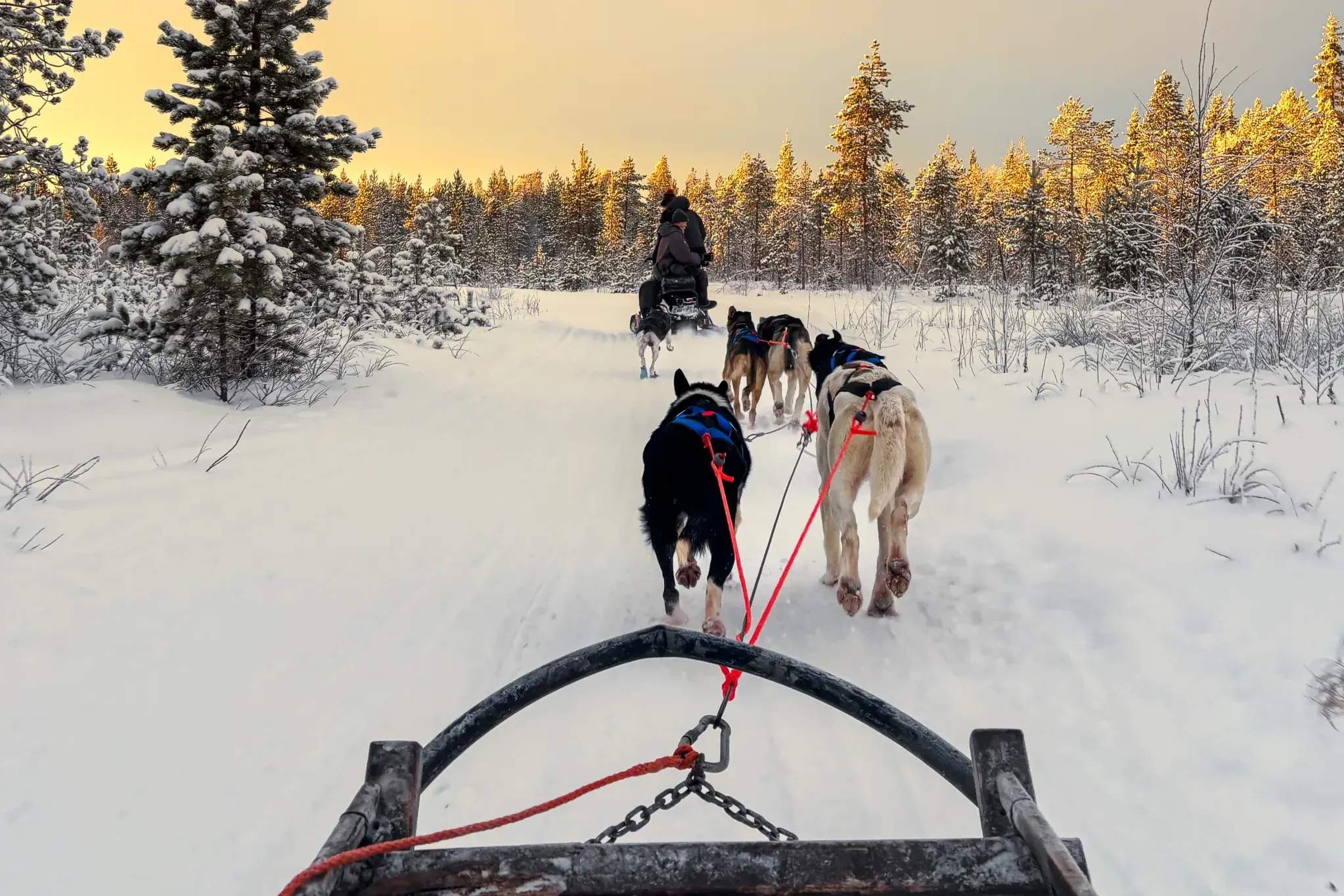
Expect roughly forty minutes of sledding inside a three-hour morning, and expect the forty minutes to be the quietest part of it. The order barely varies: a minibus out of town, twenty minutes of getting into a thermal overall and boots, a briefing, then a kennel yard where two hundred dogs are screaming to be picked. The run itself is near-silent once the brake comes up. Afterwards there is a fire, a hot drink and time with the dogs, and that last half hour is where most people say the day turned from a ride into a memory.
The sled ride is the short part. On a half-day safari it is somewhere around
forty minutes inside a three-hour morning, and if you have read anything at
all about husky tours you already know that number.
What nobody tells you is the order of the rest of it, or that the run is the
calmest thing that happens all morning. The surprises are in the other two
hours, and they are entirely manageable once you know they are coming.
First, a minibus
Kennels are not in town. You will be collected from a hotel or a central
meeting point and driven out, and the drive is somewhere between fifteen
minutes and the better part of an hour depending on whose dogs you have
booked. That difference is worth knowing in advance because it decides how
much of your day the tour eats – the
husky safari guide sets out how far the
various kennels sit from the centre and what that does to a three-hour
booking.
Two practical things about the minibus. It is warm, so do not wear everything
you own into it. And it is the last lavatory you will see for a while.
Whose minibus it is may not be whose dogs they are, which is worth knowing
before you ask the driver anything:
the names and the kennels sorts out
which companies in Rovaniemi actually keep animals.
Getting dressed is a twenty-minute job
You will be given a thermal overall, winter boots, gloves and a hat, and in
Rovaniemi this is standard rather than an extra – the tourist board lists
thermal clothing among the things provided on the sled tours it
carries.1 It goes on over what
you are already wearing, which is why the advice is always to arrive in
layers rather than in a ski jacket.
The part that takes the time is boots. They come in a rack of sizes, they are
felt-lined and enormous, and a party of eight will spend fifteen minutes
finding the right ones and getting them laced. Wear thin socks and bring a
thick pair; the boots are sized to take both.
Take your own gloves as well as the ones you are lent. Thin liner gloves under
the mitts mean you can take a hand out to work a camera or a zip without
putting it into bare air, and that one small thing is the difference between
being comfortable and counting the minutes.
The yard is loud
This is the moment people are least prepared for, and it is the best moment of
the day.
A working kennel holds anywhere from forty to several hundred dogs. When the
harnesses come out, all of them know what it means. The noise is not barking
so much as screaming – a rising, hysterical, joyful racket from every dog that
has not been picked, and the ones that have been picked are lunging into their
harnesses hard enough to drag a person.
It lasts perhaps ten minutes, while the teams are clipped into the towline.
Small children sometimes find it frightening, and it is worth telling them in
advance that the dogs are shouting because they want to go, not because
anything is wrong. Our page on
husky sledding with small children goes
into the rest of what the day asks of a four-year-old; read that one if you
are weighing whether to book at all, and this one if you have already booked
and want to know the running order.
Tripadvisor ratings, 18 Rovaniemi operators
Highest first
Snowtrail Safaris 5.0
Nordic Odyssey 5.0
Nordic Adventures 4.9
Arctic GM 4.9
Book Lapland 4.9
Bearhill Husky 4.9
Arctic Attitude 4.9
StayLapland 4.8
Wild About Lapland 4.7
Wild Nordic 4.7
Lapland Winter Park 4.6
Safartica 4.5
Nordic Unique Travels 4.5
Apukka Resort 4.4
Lapland Welcome 4.3
Arctic Circle Snowmobile Park 4.3
Arctic Circle Husky Park 4.2
Raitola 3.4
<44.04.55.0
Ratings read from Tripadvisor. The shaded compartment left of the divider holds any score below 4.0. We record the score only; review counts and review text are not part of our comparison.
Then it stops
The brake comes up and the noise ends. Not fades – ends. Twelve dogs pulling a
sled on packed snow make almost no sound at all, and the first thirty seconds
of a husky run is the single most disorienting thing about it.
If you are driving, you are standing on two runners with both hands on a bar,
one foot ready on the brake, and your entire job is to lean into the corners
and not let go. If you are in the basket you are lying back at an angle under
a blanket, close to the snow, watching the back legs of the nearest dog.
Nobody talks much. The guide’s team leads and the rest follow nose to tail,
and the trail is usually a loop through forest with two or three stops.
Distances on self-drive tours in the region run from about five kilometres to
ten,2 and the short ones are over
before you have stopped concentrating.
The cold arrives while you are sitting still
Here is the part that catches people out: the passenger gets colder than the
driver.
The driver is working – bending, braking, shifting weight – and generating
heat. The passenger is motionless at the front of a sled moving at fifteen to
twenty-five kilometres an hour, which is a headwind for the entire run. The
Finnish Meteorological Institute puts the mechanism plainly: bare skin loses
heat faster the harder the wind blows, and a strong wind makes frost feel
several degrees colder than the thermometer
says.1 A sled makes its own wind,
and it does not stop making it. How cold the air itself gets in each winter month is worked out separately from the same institute’s records.
So cover the face, not just the head. A buff or a scarf over the nose and
cheeks is the single most useful thing in your bag, and the swap point is
where you find out whether you brought one.
The fire is not filler
Afterwards there is a lavvu or a hut, a fire, and usually hot juice or coffee
and a biscuit. It reads like padding on a booking page. It is not.
This is the only part of the morning where you can stand still near the dogs
without a harness in the way, and the half hour by the fire is where people
ask the questions that make the day stick: how far these dogs run in a season,
what happens to them at fourteen, why that one is lying on its back in the
snow. The
husky farm visit exists because some
people want only this part, without the ride.
It is also when you find out that the dogs in front of your sled are not the
dogs from the brochure. Most teams in Lapland are Alaskan huskies, which
are not a recognised breed at all –
leaner, longer-legged and far more varied than the blue-eyed Siberian on the
poster.
The running order, in one list
0:00 Collection from the hotel. 0:20–0:50 Drive to the kennel.
0:50 Overall, boots, gloves. 1:10 Briefing: brake, corners, what not
to do. 1:20 The yard, the harnessing, the noise. 1:30 The run.
2:10 Back at the yard, teams unclipped. 2:20 Fire, drink, dogs.
2:50 Minibus. 3:00 Back at the hotel, warmer than you expected and
considerably louder in the ears.
Adjust for a longer trail and a further kennel and the proportions hold. The
sled is a quarter of it. The other three quarters are the reason people
remember it, and if you would rather buy a
whole team and no group at all, that
is a different purchase with the same running order.
Can two people swap over halfway, so both get to drive?
On most self-drive tours yes, and on many the guide stops specifically to let you change places. It is worth confirming when you book rather than assuming, because a few operators keep the same person on the runners for the whole run for safety reasons, and a few run trails with no sensible place to stop. If the pair of you both want a turn, say so at the briefing rather than at the swap point: the guide can plan the stop, and a team standing still in a line is easier to hold than one halted unexpectedly.
What happens if it is minus thirty on the morning we are booked?
Usually the tour runs. Sled dogs work better in hard cold than in mild weather, and an operator is far more likely to cancel for rain or a thaw than for low temperature. What changes is the briefing: expect more insistence about covering cheeks and about telling the guide immediately if your hands stop hurting, and expect the fire stop to be longer. If an operator does call it off, that is a decision about the dogs or the trail rather than about you, and a refund should follow automatically.
Is there anywhere to leave a bag, and can I take a phone out on the sled?
Bags stay in the minibus or in the changing room, and nothing is locked, so leave anything valuable at the hotel. A phone in a zipped pocket is fine and plenty of people film the run one-handed, but two warnings are worth having. Cold flattens a battery in minutes, so keep it in an inside pocket against your body until you want it. And a phone dropped from a moving sled is gone: the snow beside the trail is deep, the team does not stop, and by the time anyone walks back the hole has filled in.
Lapland Handbook is written by its editorial staff in Rovaniemi. Every price, age limit and group size in a comparison is read from the operator's own page and marked "Not stated" when the operator does not publish it. Each guide names who should not book, and names the operator that suits each kind of group, whichever it is.
Rovaniemi's winter tours do sell out – December and the week around New Year first, and the small-group ones before the rest. Booking here goes straight to the operator at their own published price, and the code LH10 takes 10% off it.
We would like to count visits, so we can see which guides get read. That needs a cookie. Nothing else on this site does, we show no advertising, and refusing changes nothing about what you can read or book. What we measure and why.