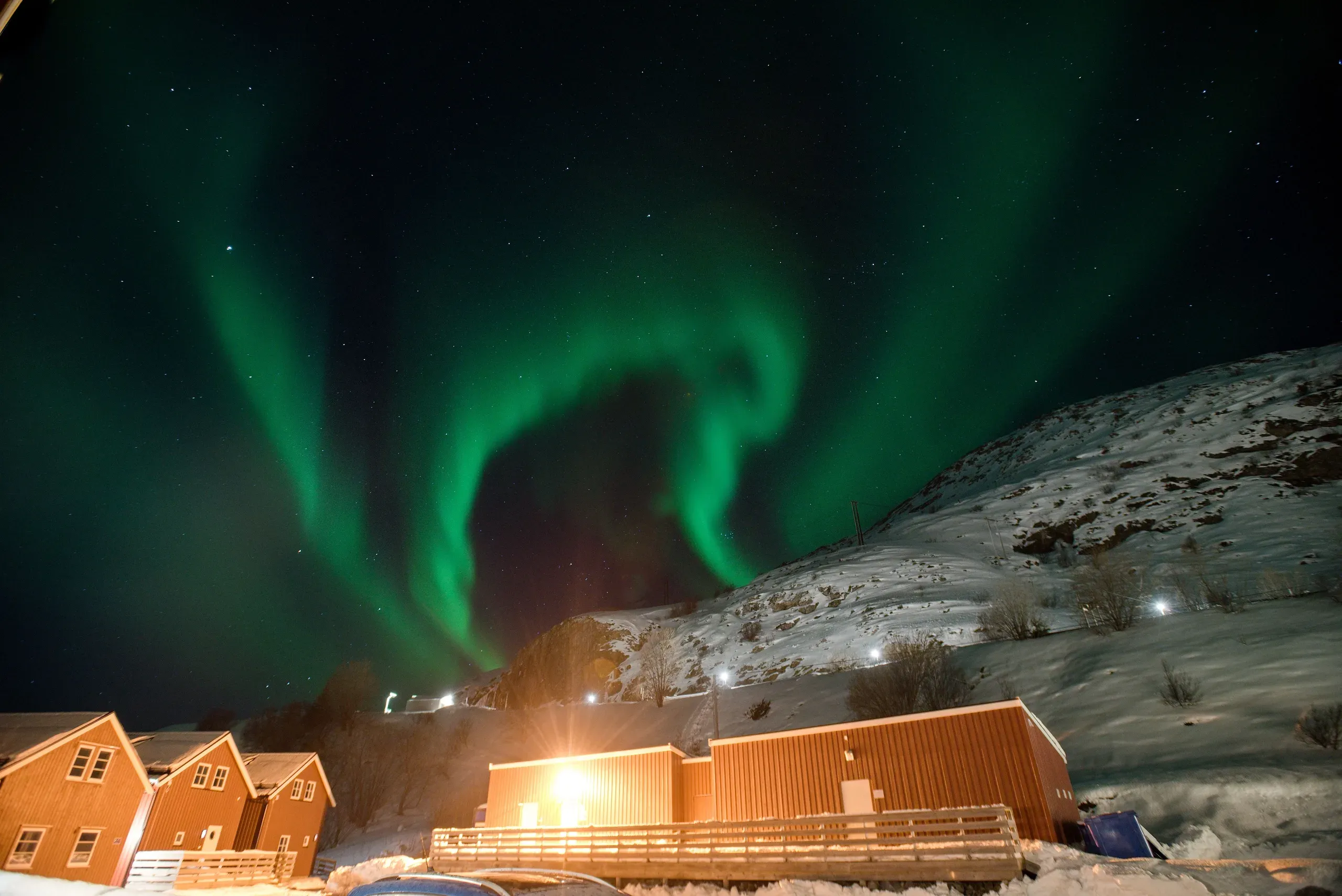
A glass igloo is a heated room with a glass roof over the bed; you sleep warm and look up. An ice hotel is built from snow and ice each winter, held between zero and minus five degrees inside, with a sleeping bag instead of a duvet and the bathrooms in a separate heated building. An aurora cabin is the ambiguous one: sometimes a heated cabin you sleep in, and just as often a two-to-four-hour evening where you sit by a fire and go outside when something appears. Decide first whether you want a night or an evening, and second whether you want to be warm.
Search for somewhere to sleep under the northern lights and three phrases come
back mixed together, as though they were the small, medium and large of one
product. They are not related in that way at all.
The distinction that matters is not how much they cost. It is whether you are
buying a night or an evening, and whether the room is heated.
Glass igloo: a warm room with a glass roof
The original and still the clearest of the three. A small heated structure
with a glass roof over the bed, so you can lie down and see the sky. At
Kakslauttanen, which built the first of them, the published sizes run from a
small igloo sleeping up to three to a Kelo-glass version taking up to six, and
they are sold across the aurora season, which the resort dates from about the
third week of August to the end of
April.1
Note the season: it starts in late summer. That is a genuinely useful thing to
know, because the aurora does not wait for snow, and August and September
nights are far more comfortable to stand outside in.
What a glass igloo is not is a dark-sky site. It is part of a resort, with a
resort’s lighting, and
where else in Finland to see the northern lights
makes the case that the two things you control are darkness within reach and
the number of nights you buy. A glass roof is neither.
Ice hotel: cold on purpose, and rebuilt every year
A different proposition entirely. Arctic SnowHotel near Rovaniemi has built a
new hotel out of snow and ice every year since December 2008; the rooms are
held between zero and minus five degrees, you sleep on a mattress in a
sleeping bag rated for extreme conditions, and the showers and changing rooms
are in a separate building with the sauna. It opens to hotel guests on 15
December and runs to the end of
March.2
Three consequences people do not anticipate. The rooms have no bathrooms, so
the night involves a walk in the cold. There are no windows, so the aurora is
not visible from the bed and never was – an ice hotel is not a lights product
at all. And because it melts, it is genuinely a different building each year,
which is the real reason to go.
Tripadvisor ratings, 18 Rovaniemi operators
Highest first
Snowtrail Safaris 5.0
Nordic Odyssey 5.0
Nordic Adventures 4.9
Arctic GM 4.9
Book Lapland 4.9
Bearhill Husky 4.9
Arctic Attitude 4.9
StayLapland 4.8
Wild About Lapland 4.7
Wild Nordic 4.7
Lapland Winter Park 4.6
Safartica 4.5
Nordic Unique Travels 4.5
Apukka Resort 4.4
Lapland Welcome 4.3
Arctic Circle Snowmobile Park 4.3
Arctic Circle Husky Park 4.2
Raitola 3.4
<44.04.55.0
Ratings read from Tripadvisor. The shaded compartment left of the divider holds any score below 4.0. We record the score only; review counts and review text are not part of our comparison.
Aurora cabin: the ambiguous one
Here is where the categories break down, because the phrase is used for two
different things.
Sometimes it means a heated timber cabin with a large window or a glass gable,
sold as a night’s accommodation – effectively a glass igloo with more wood and
more floor. Northern Lights Village is the
best-known example, and the page on it is also where to find out that the name
covers two resorts 250 kilometres apart rather than one place.
Just as often it means an evening: three or four hours in a heated hut at a
dark site out of town, with a fire, something to eat and somebody watching the
sky for you, ending with a drive back to your own hotel. That is what
an aurora cabin evening is on this site, and it
is a fundamentally different purchase from a bed.
Check which one a listing means before comparing prices, because the two
differ by an order of magnitude and neither is a version of the other.
Which to choose
You want to see the aurora, and that is the point: neither glass nor ice.
Buy nights and mobility. The
northern lights guide sets out what a
tour can and cannot change, and the honest summary is that going somewhere
dark, repeatedly, beats sleeping under any roof.
You want a memorable room and would be pleased if the sky performed: a
glass igloo. Heated, comfortable, and genuinely lovely on the night it works.
You want the building itself to be the experience: the ice hotel, one
night, inside a longer stay somewhere warm.
You want an evening rather than a night: an aurora cabin evening, or a
chase by minibus if you would rather move
than wait. Which of those suits you is a real decision, and
which month to come matters
more than either.
This page is an independent guide. We have no connection to the hotels named,
and neither has seen what it says.
Will we actually see the aurora from a glass igloo?
Sometimes, and less often than the photographs suggest. Two things work against it. The first is cloud, which ends most aurora nights in Lapland regardless of what you are lying under. The second is that a glass igloo is part of a resort, and resorts have outdoor lighting: a strong display will show through it, a faint one will not. The igloo is a lovely way to spend a night and a poor insurance policy. If seeing the lights is the point of the trip, buy nights rather than glass.
Is a night in an ice hotel actually comfortable?
It is survivable and interesting rather than comfortable, and the operators are fairly honest about that. You sleep on a mattress inside an expedition sleeping bag in a room held between zero and minus five, with your clothes in the heated building because anything left in the room will be cold in the morning. The lavatory is a walk. Most people find one night memorable and two unnecessary, which is exactly how the hotels sell it – usually as one night inside a longer stay in warm rooms.
Can children sleep in either of these?
In a glass igloo, easily: it is a heated room, the sizes go up to five or six people, and the only practical question is whether a child will sleep with a glass roof and no curtain. In an ice hotel, treat it with more caution. A cold night in a sleeping bag is a poor place to discover that a small child hates being cold, there is no quick way to warm up in the room itself, and a broken night for one becomes a broken night for everybody. Check each hotel's own minimum age before assuming.
Lapland Handbook is written by its editorial staff in Rovaniemi. Every price, age limit and group size in a comparison is read from the operator's own page and marked "Not stated" when the operator does not publish it. Each guide names who should not book, and names the operator that suits each kind of group, whichever it is.
Rovaniemi's winter tours do sell out – December and the week around New Year first, and the small-group ones before the rest. Booking here goes straight to the operator at their own published price, and the code LH10 takes 10% off it.
We would like to count visits, so we can see which guides get read. That needs a cookie. Nothing else on this site does, we show no advertising, and refusing changes nothing about what you can read or book. What we measure and why.