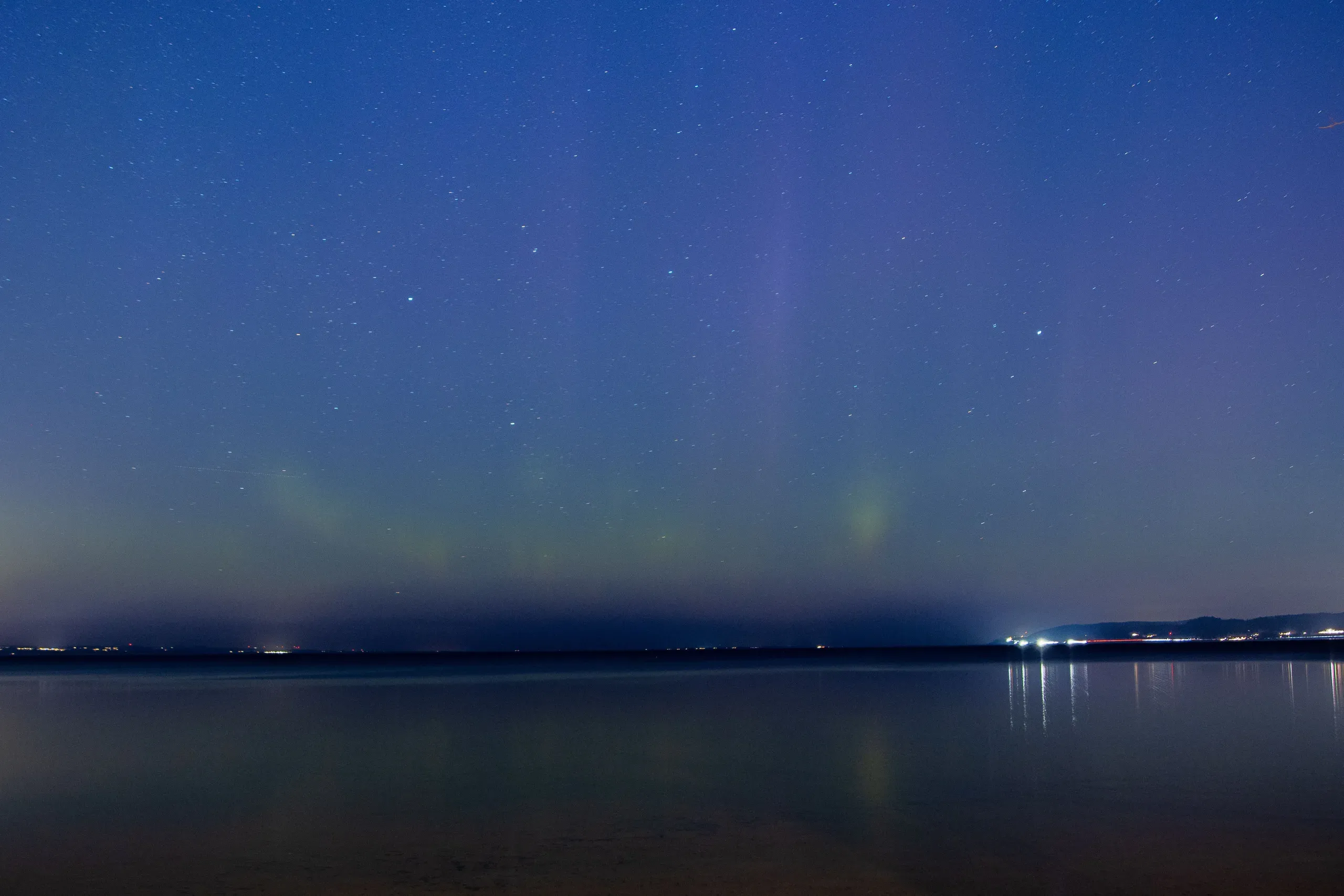
Read it in layers, and never from one number. The planetary index tells you days ahead whether the sun is likely to be busy, but it is a global storm gauge rather than a Rovaniemi reading. The half-hour map tells you what the next hour looks like. The Meteorological Institute's local index tells you what is happening overhead right now and makes no promise about later. None of the three knows whether it is cloudy, so check that separately and first.
Open any aurora app in Rovaniemi and you get a number, a coloured map and
sometimes a bar chart, presented as though they were one forecast. They are three
different instruments, answering three different questions on three different
timescales, and reading them in the wrong order is how people end up standing
in a car park under cloud.
Days ahead: the Kp number
The number most apps put first is Kp, and it is the NOAA northern lights
forecast that most of them quote. It measures
disturbance in the Earth’s magnetic field on a scale from 0 to 9, where 1 is calm and 5 or more is a
geomagnetic storm, over three-hour
intervals.1
The part that matters for Rovaniemi is where it comes from. Kp is the average
of 13 observatories between 44 and 60 degrees of geomagnetic latitude, north and
south.1 It is a planetary storm
gauge, built from stations a long way from the Arctic Circle, and it knows
nothing about the sky above your hotel.
Use it for what it is good at: a few days out, a raised Kp says the sun is
likely to be busy, and that is a reason to keep evenings free. The card on this
site’s home page shows NOAA’s Kp forecast for exactly that purpose, next to the
cloud cover.
The next hour: the 30-minute map
The oval-shaped map is a model called OVATION, and NOAA describes it as a 30 to
90 minute forecast of where the aurora will be and how strong. Its lead time is
the time the solar wind takes to travel from a measuring point about
1.6 million kilometres upstream of the Earth to
us.2
That makes it the tool for dinner time. It cannot say anything about tomorrow,
but it can tell you whether the next hour is worth putting boots on for.
Tripadvisor ratings, 18 Rovaniemi operators
Highest first
Snowtrail Safaris 5.0
Nordic Odyssey 5.0
Nordic Adventures 4.9
Arctic GM 4.9
Book Lapland 4.9
Bearhill Husky 4.9
Arctic Attitude 4.9
StayLapland 4.8
Wild About Lapland 4.7
Wild Nordic 4.7
Lapland Winter Park 4.6
Safartica 4.5
Nordic Unique Travels 4.5
Apukka Resort 4.4
Lapland Welcome 4.3
Arctic Circle Snowmobile Park 4.3
Arctic Circle Husky Park 4.2
Raitola 3.4
<44.04.55.0
Ratings read from Tripadvisor. The shaded compartment left of the divider holds any score below 4.0. We record the score only; review counts and review text are not part of our comparison.
Right now: the Institute’s R-index
For an actual Rovaniemi northern lights forecast, in the sense of what is
happening overhead, the useful source is Finnish rather than American. The
Finnish Meteorological Institute’s R-index is a local measurement from
magnetometers, calculated over a ten-minute window of readings taken every ten
seconds, and the Institute is explicit about its limit: it is a nowcast, and it
does not forecast the future.3
It is read by colour. Yellow means a 50 per cent probability of weak auroras,
red a 50 per cent probability of strong ones, and the Institute’s advice is to
follow the station whose latitude is closest to
yours.3
The thresholds behind those colours are recent. The Institute redefined them in
January 2024, moving from one threshold to two and recalculating every five
minutes instead of ten, and it set them against 146,747 pictures from its aurora
cameras at Kevo, Muonio and Hankasalmi, showing 463 hours of
displays.4 Among the northern
lights forecasts for Finland, this is one that has been checked against the
Finnish sky itself.
What none of them shows
Not one of the three says whether it is cloudy. A red bar under a solid
overcast is a display you will not see, and cloud is what decides most evenings
in Rovaniemi, as the
northern lights guide explains. Look at
the cloud forecast before any of the above, not after.
Reading them in order
In the afternoon, glance at Kp to know whether the sun is busy this week. Once
it is dark, check the cloud. If there are gaps, look at the half-hour map. Once
you are outside, watch the R-index for your nearest station and give it until
around midnight, because
the hour is one of the levers that actually moves your odds.
If you are weighing a tour, the forecast is the same one the operators read,
which is why
who runs the Rovaniemi aurora tours
argues that the difference between them is somewhere else.
This page is an independent guide, written from published sources. We have no
connection to any aurora tour operator.
Nobody publishes a Rovaniemi threshold for Kp, and it is the wrong question to hang an evening on. The index is an average from observatories far to the south, taken over three hours, so a quiet figure does not rule out a display overhead and a high one does not produce it through cloud. Treat a raised Kp as a reason to keep checking, and let the Institute's local reading, taken once it is dark, make the decision.
The map is green over Lapland in the middle of the afternoon. Why can I not see anything?
Because the model draws the aurora whether or not the sun is up. NOAA says plainly that the aurora is not visible in daylight, and the model does not check whether it is dark where you are standing. A green oval in daylight is information about the particles arriving, not an invitation to go outside; look again once the sky is properly dark, when the same colour on the map means something you can act on.
Can I plan a particular night a week from now?
Not from any of these tools. The planetary forecast looks a few days ahead at most, the half-hour map runs on the solar wind already on its way, and the Institute's index measures only what is happening now. What does work at a week's distance is to keep several evenings free, so that when a clear night and an active sky coincide you are in a position to use it.
Lapland Handbook is written by its editorial staff in Rovaniemi. Every price, age limit and group size in a comparison is read from the operator's own page and marked "Not stated" when the operator does not publish it. Each guide names who should not book, and names the operator that suits each kind of group, whichever it is.
Rovaniemi's winter tours do sell out – December and the week around New Year first, and the small-group ones before the rest. Booking here goes straight to the operator at their own published price, and the code LH10 takes 10% off it.
We would like to count visits, so we can see which guides get read. That needs a cookie. Nothing else on this site does, we show no advertising, and refusing changes nothing about what you can read or book. What we measure and why.