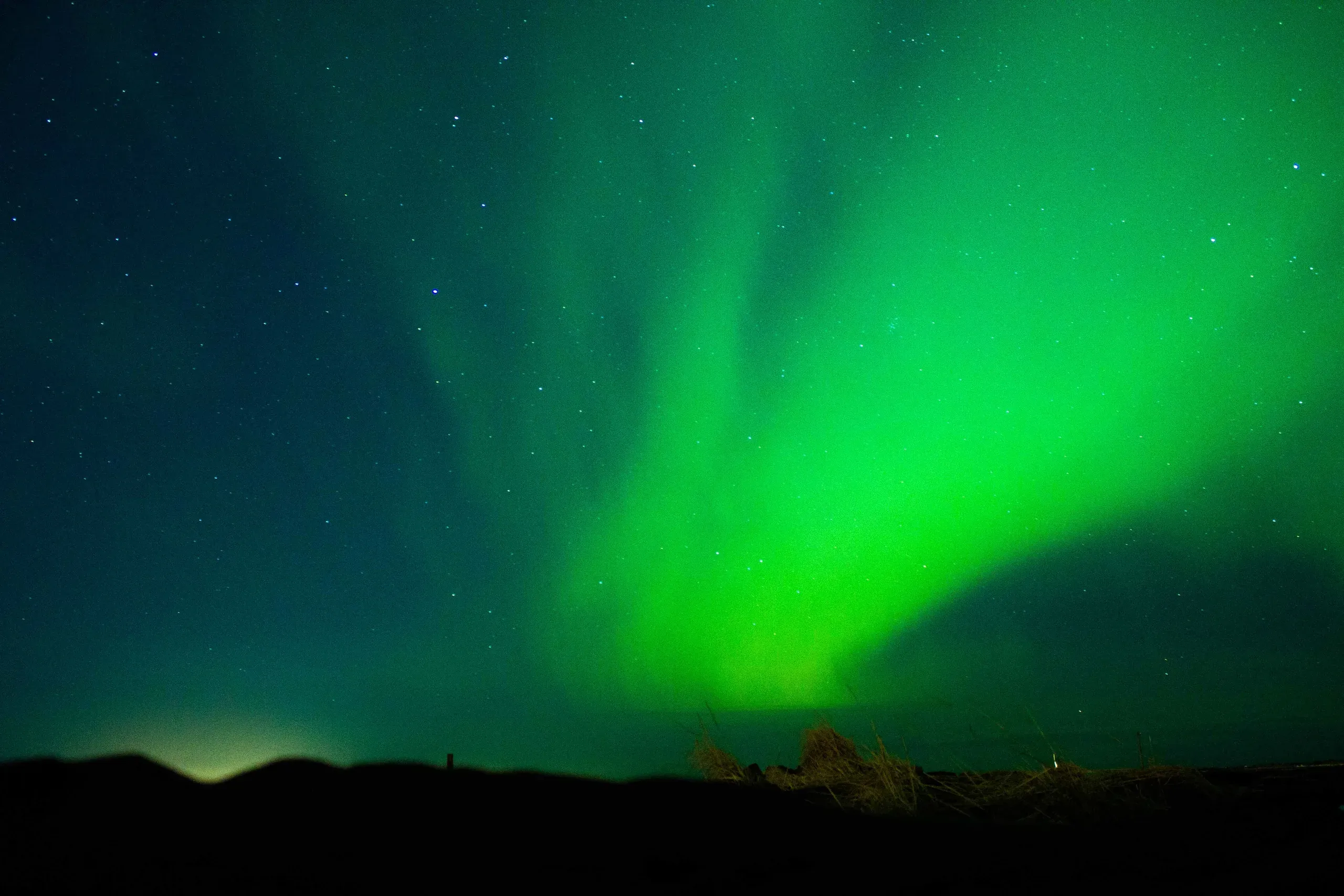
The northern lights are the upper atmosphere glowing. Energy carried from the Sun is stored in Earth's magnetic field and released in bursts, and the field funnels it down towards a ring around the magnetic pole, where it makes the air shine. Lapland sits under that ring, which is why it sees the aurora so often. Because the light is far above the weather, a clear sky matters more than anything you can do on the ground. 'Aurora borealis' and 'northern lights' are two names for the same thing.
The short version fits in one sentence: particles from the Sun, steered by
Earth’s magnetic field, hit the upper atmosphere and make its gases glow. Each
part of that sentence explains something you will notice on a night out in
Lapland, so it is worth taking them one at a time.
The Sun supplies the energy
The Sun sends out a constant stream of charged particles, the solar wind. When
it meets Earth’s magnetic field, it can leave energy there, and the energy
builds up until it is released, much of it raining down into the atmosphere as
the aurora.1 The large clouds of
material the Sun throws out from time to time, coronal mass ejections, can load
the field far more than the steady stream
does.1
That is the reason the aurora comes and goes in bursts rather than shining
steadily all night: what you see is stored energy being let go, not sunlight
being reflected.
The magnetic field decides where
The released energy does not fall evenly. The particles are accelerated on the
night side of the magnetic field and follow it down towards the poles, so the
aurora forms two rings, one centred on each magnetic pole. The best place to
stand is under one of them, roughly between 60 and 75 degrees of
latitude.2
Finnish Lapland lies inside that band – Rovaniemi is on the
Arctic Circle – and that, rather than
the cold or the dark, is why the aurora is a Lapland thing. The south of Finland
is at the edge of the ring, which is why
seeing it from Helsinki takes an unusually
strong night.
Tripadvisor ratings, 18 Rovaniemi operators
Highest first
Snowtrail Safaris 5.0
Nordic Odyssey 5.0
Nordic Adventures 4.9
Arctic GM 4.9
Book Lapland 4.9
Bearhill Husky 4.9
Arctic Attitude 4.9
StayLapland 4.8
Wild About Lapland 4.7
Wild Nordic 4.7
Lapland Winter Park 4.6
Safartica 4.5
Nordic Unique Travels 4.5
Apukka Resort 4.4
Lapland Welcome 4.3
Arctic Circle Snowmobile Park 4.3
Arctic Circle Husky Park 4.2
Raitola 3.4
<44.04.55.0
Ratings read from Tripadvisor. The shaded compartment left of the divider holds any score below 4.0. We record the score only; review counts and review text are not part of our comparison.
The air makes the light
The glow itself comes from the particles striking oxygen and nitrogen in the
upper atmosphere, typically between 80 and 500 kilometres
up.2 Each gas shines in
its own colours at its own height: the familiar green is oxygen, at roughly 100 to 200
kilometres.1
Weather happens far below that. The aurora is always above the clouds, never in
or under them, which is why a clear sky is the one condition on the ground that
decides whether you see it.
Aurora borealis or northern lights?
The same thing. Aurora is the Latin word for dawn and the name of the Roman
goddess of the dawn, so aurora borealis means “northern dawn”; its southern
counterpart is the aurora australis, the southern
lights.1 Tour operators and
forecasts use the two English names interchangeably, and so does this site.
Why nobody can promise you a display
Put the three steps together and the uncertainty is built in. The release of
stored energy is not on a timetable, and the Finnish Meteorological Institute
says plainly that auroras can never be predicted
accurately.3 What can be measured
is how disturbed the magnetic field is right now, and
reading a Rovaniemi aurora forecast
shows how to turn that into a decision about tonight.
Does it have to be cold to see the northern lights?
No. The cold has nothing to do with the aurora itself, which happens far above any weather. What people notice is that the coldest nights tend to be the clear ones, because a cloud layer holds warmth in, and a clear sky is what lets you see the light. A mild clear night is just as good as a freezing one, and a bitter night under cloud shows you nothing at all.
Do the northern lights make a sound?
People have reported crackling under strong displays for a long time, and an Aalto University acoustics researcher, Unto K. Laine, has recorded popping and crackling sounds and located their source about seventy metres above the ground. His explanation is that charge builds up in a layer of air where temperature changes with height and is released during a magnetic storm. It is a researcher's proposal rather than settled science, and most displays are silent.
Is there a southern version at the same time?
Yes. The aurora forms two ovals, one around each magnetic pole, so the same activity that lights the sky over Lapland lights the far south too. The southern display is called the aurora australis, or southern lights. Very few people see it, because most of the land under the southern oval is Antarctica and the open ocean around it, which is why the northern lights are the famous half of the pair.
Lapland Handbook is written by its editorial staff in Rovaniemi. Every price, age limit and group size in a comparison is read from the operator's own page and marked "Not stated" when the operator does not publish it. Each guide names who should not book, and names the operator that suits each kind of group, whichever it is.
Rovaniemi's winter tours do sell out – December and the week around New Year first, and the small-group ones before the rest. Booking here goes straight to the operator at their own published price, and the code LH10 takes 10% off it.
We would like to count visits, so we can see which guides get read. That needs a cookie. Nothing else on this site does, we show no advertising, and refusing changes nothing about what you can read or book. What we measure and why.