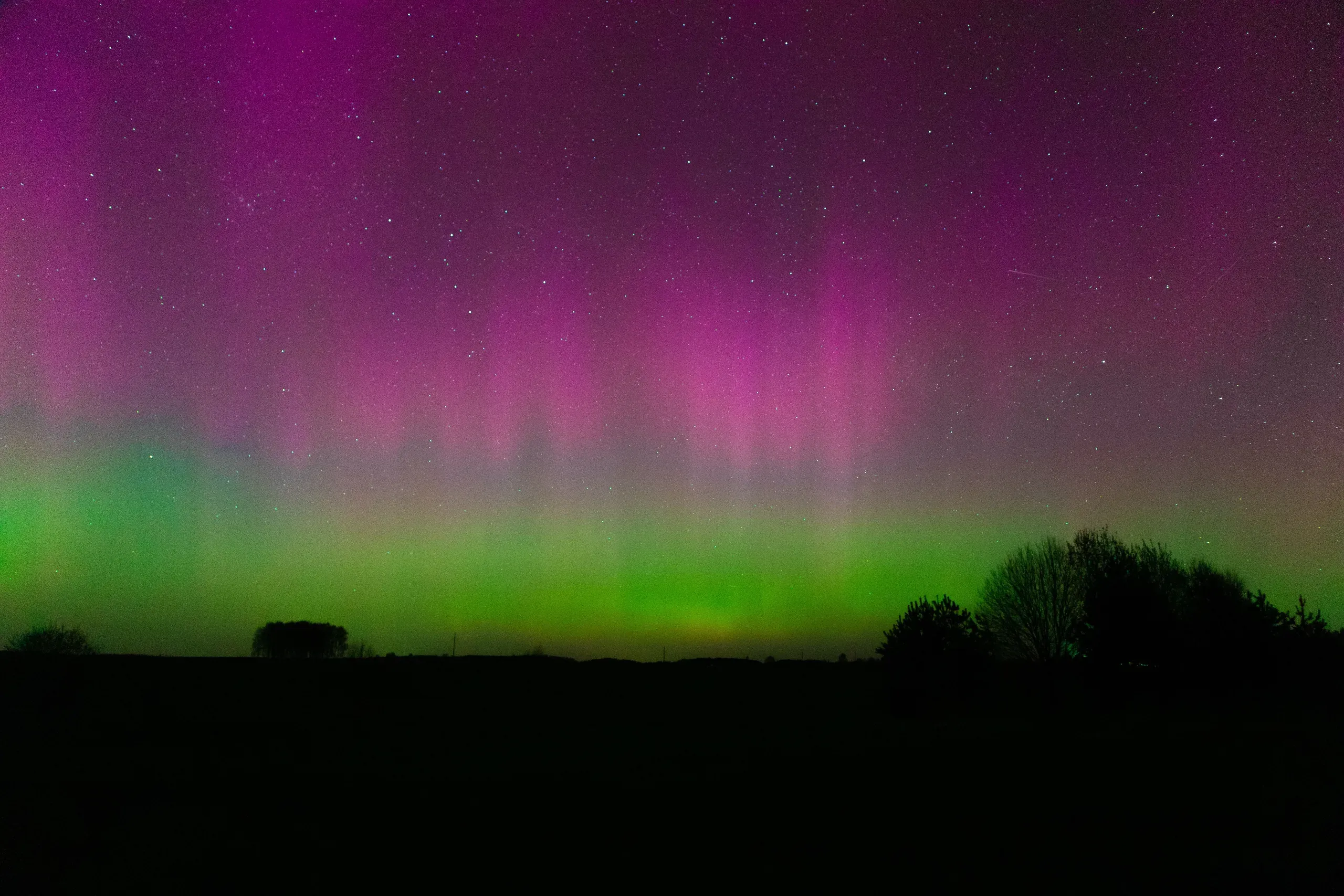
The colour tells you how high the light is and which gas is glowing. Green, the usual colour, is oxygen at middle height; red is oxygen higher up; blue and the pink or purple fringe at the bottom come from nitrogen. A red or purple aurora is not a different phenomenon or a bad sign, just more of the display reaching heights and gases you can see. And if the sky looked grey but your photo is vivid, nothing is wrong with your eyes: cameras gather far more light than they do.
The aurora’s colours look like decoration, and most descriptions treat them
that way. They are more useful read as a map. Each colour is one gas glowing at
one height, so a display that changes colour from top to bottom is showing you
its structure.
The colour is the height
The particles that cause the aurora strike the gases of the upper atmosphere,
and each gas gives off its own light at its own altitude. Oxygen produces two of
the colours: green, roughly between 100 and 200 kilometres up, and red, above
200 kilometres. Nitrogen at 100 to 200 kilometres glows blue, and below about
100 kilometres it gives the lower edge of the aurora a reddish-purple to pink
glow.1
So a display that is green in the middle, pink along its bottom edge and red at
the top is one curtain of light reaching through three layers of air.
Why most of it is green
Green comes from the middle band of the display, and over Lapland, where the aurora is
often overhead or close to it, that bright middle band is what you look
straight at. The other colours are there too, fainter, and when the light of
different gases mixes the aurora can look purple, pink or even
white.1
Tripadvisor ratings, 18 Rovaniemi operators
Highest first
Snowtrail Safaris 5.0
Nordic Odyssey 5.0
Nordic Adventures 4.9
Arctic GM 4.9
Book Lapland 4.9
Bearhill Husky 4.9
Arctic Attitude 4.9
StayLapland 4.8
Wild About Lapland 4.7
Wild Nordic 4.7
Lapland Winter Park 4.6
Safartica 4.5
Nordic Unique Travels 4.5
Apukka Resort 4.4
Lapland Welcome 4.3
Arctic Circle Snowmobile Park 4.3
Arctic Circle Husky Park 4.2
Raitola 3.4
<44.04.55.0
Ratings read from Tripadvisor. The shaded compartment left of the divider holds any score below 4.0. We record the score only; review counts and review text are not part of our comparison.
Why red is the colour seen far away
Red glows highest. Light from far up can be seen from further away, which is
why, on the rare nights the aurora is seen far south of Lapland, the part that
reaches over the horizon is often the red top rather than the green middle.
Further north, under the display, the same night is mostly green.
Your eyes and your camera disagree
This is where most of the confusion starts. When the aurora is faint, the eye
sees it mainly with the cells that work in low light but cannot detect colour,
so it looks grey or greyish-green. Cameras gather far more light and record more
of the aurora and more of its colours, and people differ in how much colour they
see at all.2
That is why a pale grey arc can come out bright green with a purple fringe on a
phone screen. Neither is false: the photograph records light that was there,
which your eyes could not collect fast enough.
Photographing the northern lights with a phone
covers getting that picture, and
what causes the northern lights
covers where the light comes from in the first place.
Not by itself. Red is simply the colour oxygen gives off highest up, and some red is part of many ordinary displays even if the eye misses it. What is true is that the big storms people remember from far south of Lapland were often seen as red, because the high part of a display is the part visible from a long way off.
Why does my friend see colours I cannot?
Because eyes differ. People have different proportions of the colour-sensing cells in the eye, and it is normal for two people standing side by side to see different amounts of colour in the same faint aurora. Give your eyes time to adjust to the dark, keep phone screens dim, and you will usually see more colour once your eyes have fully adjusted than in the first minutes outside.
Is a white aurora real?
Yes. When the light from different gases mixes, the aurora can look white, pink or purple rather than any single pure colour, and a faint display seen mostly with the light-sensitive but colour-blind cells in the eye looks grey or whitish too. A pale band that moves, pulses or forms rays is very likely aurora even if it shows no colour to you; point a phone camera at it and the colour usually appears.
Lapland Handbook is written by its editorial staff in Rovaniemi. Every price, age limit and group size in a comparison is read from the operator's own page and marked "Not stated" when the operator does not publish it. Each guide names who should not book, and names the operator that suits each kind of group, whichever it is.
Rovaniemi's winter tours do sell out – December and the week around New Year first, and the small-group ones before the rest. Booking here goes straight to the operator at their own published price, and the code LH10 takes 10% off it.
We would like to count visits, so we can see which guides get read. That needs a cookie. Nothing else on this site does, we show no advertising, and refusing changes nothing about what you can read or book. What we measure and why.