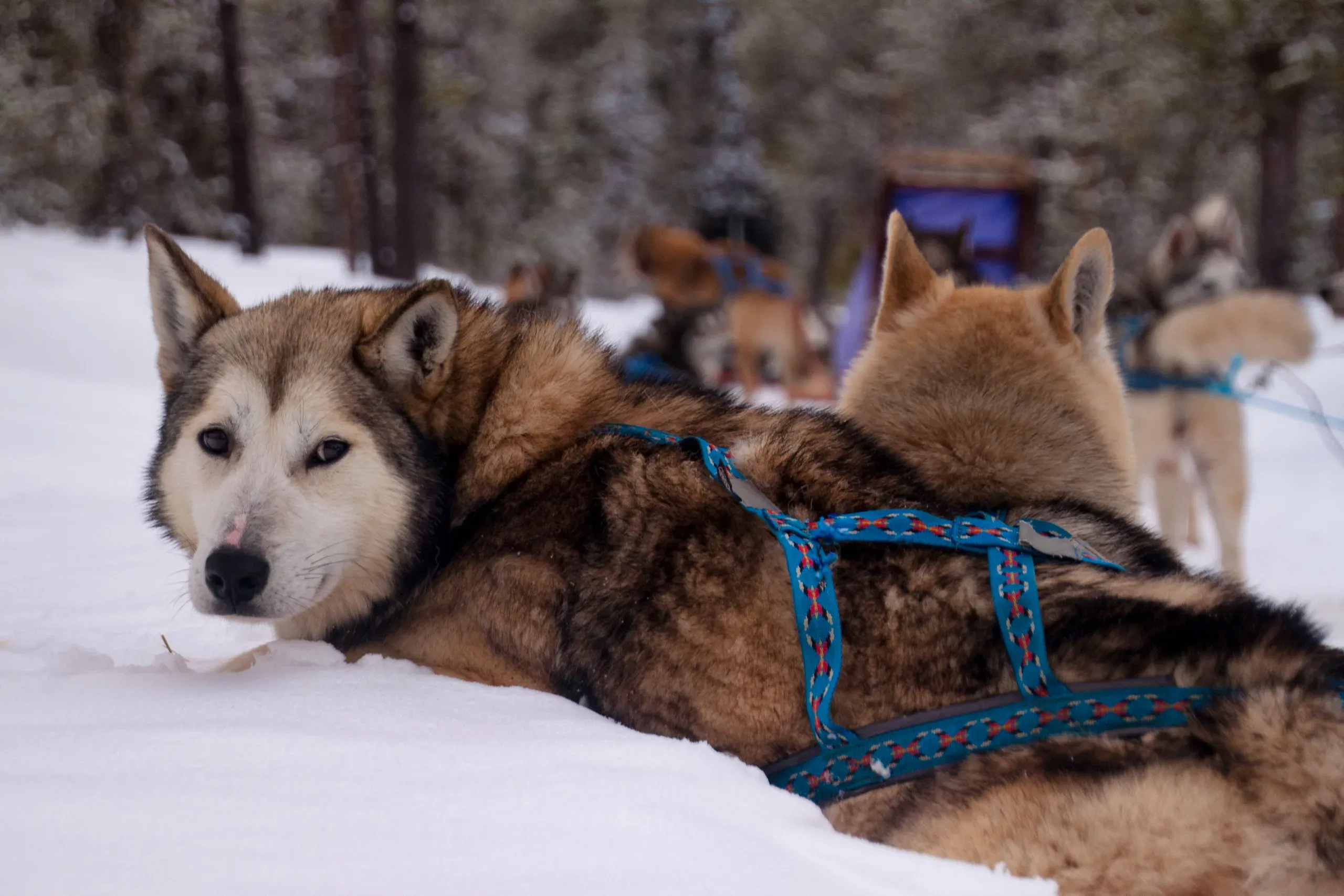
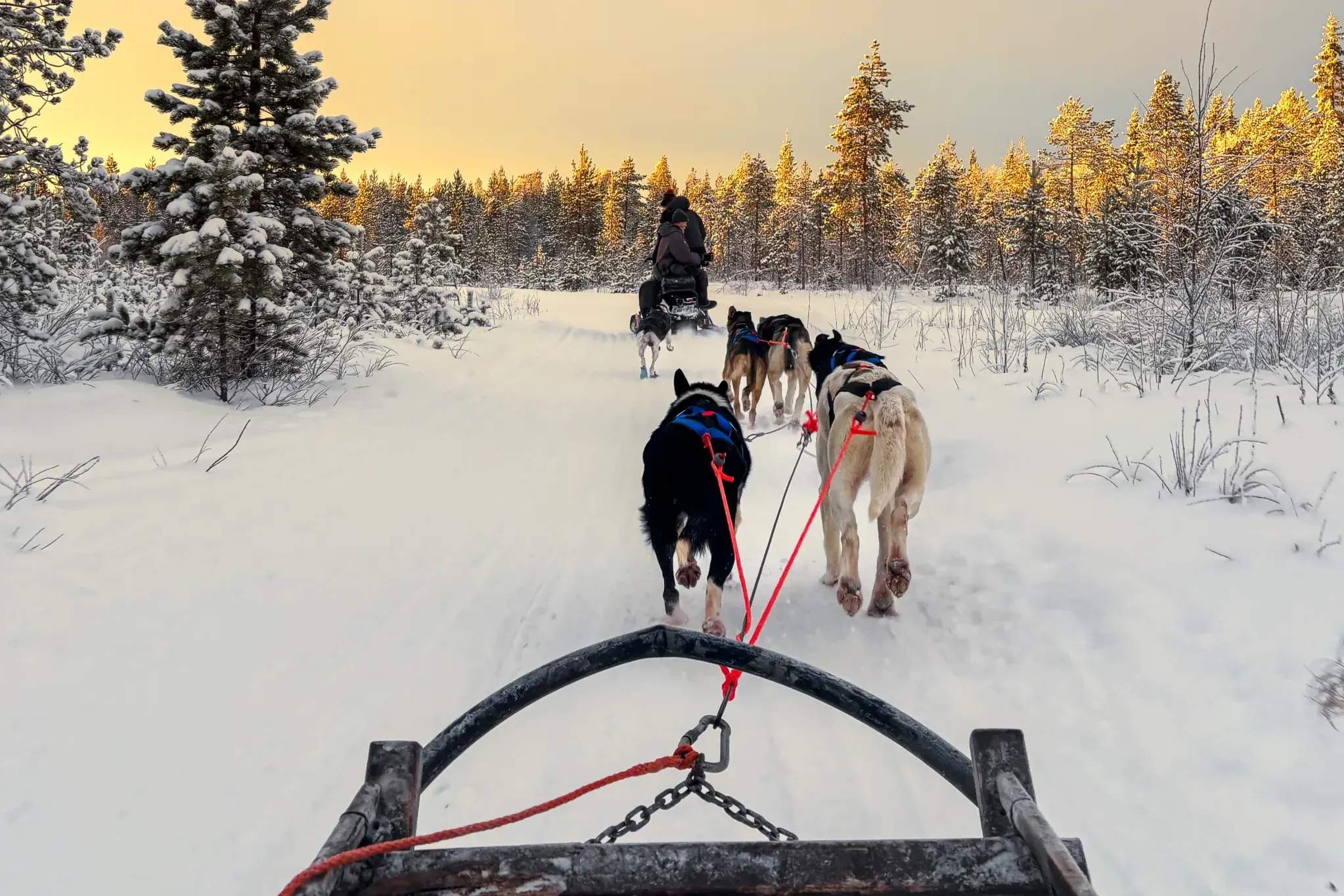
Book the safari if you want the run, and the visit if you want the dogs. They are not cheap and expensive versions of one thing. A safari is roughly forty minutes of sledding inside a half-day, and for most of it the dogs are ahead of you, working, and you are watching the back of a team. A visit puts you in the kennel with animals that are not in harness, which is the only setting in which you can see how they are kept and ask about it. If the party includes anyone who cannot or does not want to sit in a sled, the visit is not the consolation prize – it is the better product.
The comparison is nearly always made on price, and that framing gets it wrong
from the first line. A farm or kennel visit is not a budget husky safari. It
is the other half of the same subject, and the two ask completely different
things of both you and the dogs.
On a safari the dogs are at work
For the forty minutes that matter you are behind them. They are pulling, you
are either standing on the runners or lying in the basket, and the relationship
is entirely one-directional: you watch a team from the rear while it does its
job. The
husky safari minute by minute
describes the shape of that morning, including the ten minutes in the yard
which is the only part of it where you and the dogs are in the same place at
the same speed.
This is not a complaint. A working team at a trot is genuinely one of the
better things you can see in Lapland, and the point of the product is the
movement. It is also what pays for the rest of the dogs’ year, which is the
subject of
why a husky safari costs what it does.
But if what you imagined was meeting dogs, a safari delivers about ten minutes
of it inside three hours.
It is also worth putting the distances in proportion. A tourist safari of
eight or ten kilometres sounds substantial, and for you it is. For the dogs
it is the short end of the sport: the Finnish Kennel Club’s sled dog
competition classes run about 10 km for a three or four dog team, 15 to 20 for
six and 20 to 25 for eight, an open class usually over 30 km, mid-distance
races of 60 to 150 kilometres in a day, and stage races that accumulate more
than 500.1 The team in front of
your sled is not being stretched. It is doing a warm-up.
On a visit they are off duty
Take the sled away and the encounter inverts. The dogs are loose or tethered
in their own yard, not lined out on a towline, and they behave like dogs:
leaning on people, rolling in the snow, ignoring you entirely. The
husky farm visit guide sets out which
Rovaniemi operators sell this and when – the honest answer is that it is
scarcer in midwinter than people expect, because the kennels are busy selling
rides.
What the format gives you that nothing else does is the kennel itself. You can
see how many dogs there are, what they sleep in, whether there is water in
front of them and what the old ones are doing. That is the whole argument for
booking one.
Tripadvisor ratings, 18 Rovaniemi operators
Highest first
Snowtrail Safaris 5.0
Nordic Odyssey 5.0
Nordic Adventures 4.9
Arctic GM 4.9
Book Lapland 4.9
Bearhill Husky 4.9
Arctic Attitude 4.9
StayLapland 4.8
Wild About Lapland 4.7
Wild Nordic 4.7
Lapland Winter Park 4.6
Safartica 4.5
Nordic Unique Travels 4.5
Apukka Resort 4.4
Lapland Welcome 4.3
Arctic Circle Snowmobile Park 4.3
Arctic Circle Husky Park 4.2
Raitola 3.4
<44.04.55.0
Ratings read from Tripadvisor. The shaded compartment left of the divider holds any score below 4.0. We record the score only; review counts and review text are not part of our comparison.
The kennel is where the answerable questions live
Finland changed the rules on keeping dogs at the start of 2024, and the
detail that matters here is a specific exemption. A dog’s permanent home must
now have unfrozen water available continuously – except that professional
sled dog kennels do not have to provide it in freezing weather, provided the
dogs are watered at least three times a
day.2
That exemption exists for an obvious practical reason, and it is also a
perfectly good question to put to a kennel: how often, and who checks. The
same goes for the things no booking page publishes – how many dogs are kept,
how often each one runs, what happens to a dog that stops working, and whether
retired dogs stay.
None of that is visible from a sled. All of it is visible, or at least
askable, on a visit. Our page on
which dogs actually pull the sled
makes the related point that the type tells you nothing about welfare: the
kennel does, and only one of these two products shows it to you.
Which to book
You want the run: the safari, and pick it on trail distance and group
size, which is what the
husky safari guide is for.
You want the dogs: the visit. Longer with the animals, no minimum age
worth the name, and abandonable after twenty minutes if the weather or a
child turns.
You want both and have one morning: a visit with a short ride attached,
sold at the park at Santa Claus Village among other places. What that actually
consists of, and what it costs against a full safari, is set out on
Arctic Circle Husky Park.
Somebody in the party cannot sit in a sled: the visit, without
apology. It is the better product for that group rather than the lesser one,
and treating it as a downgrade is the most common mistake in this whole
decision.
Is a farm visit a cheaper way of getting the same thing?
No, and treating it that way is how people end up disappointed by both. The visit has no sled in it, so if the image in your head is a team pulling away down a forest trail, a visit will not supply it at any price. What it supplies instead is time and proximity: dogs out of harness, a kennel you can walk through, and a guide with nothing to do for an hour but answer questions. Those are worth paying for on their own terms, and they are not available on a safari.
Which is better with a toddler who cannot sit still?
The visit, almost always, and the reason is not safety but structure. A safari commits a small child to a fixed period strapped into a sled behind a moving team, with no way to stop early without disrupting the group. A visit can be abandoned after twenty minutes with nothing lost, moves at whatever pace the child sets, and has a warm building attached in most cases. It also has no minimum age worth speaking of, whereas safaris commonly start at three or four.
Can we do a visit and a very short ride in the same place?
Often yes, and in Rovaniemi it is the most common shape of the visit-plus-ride product: a walk around the kennel, time with the dogs, and a loop of a kilometre or two on a shared sled driven by staff. It is worth knowing that a ride of that length is a different experience from a safari rather than a shorter one – you are a passenger for a couple of minutes, and the team barely gets into its stride. Treat it as an addition to the visit, not as a substitute for the safari.
Lapland Handbook is written by its editorial staff in Rovaniemi. Every price, age limit and group size in a comparison is read from the operator's own page and marked "Not stated" when the operator does not publish it. Each guide names who should not book, and names the operator that suits each kind of group, whichever it is.
Rovaniemi's winter tours do sell out – December and the week around New Year first, and the small-group ones before the rest. Booking here goes straight to the operator at their own published price, and the code LH10 takes 10% off it.
We would like to count visits, so we can see which guides get read. That needs a cookie. Nothing else on this site does, we show no advertising, and refusing changes nothing about what you can read or book. What we measure and why.